
coax to hollow waveguide
could somebody please explain why there is a lambda/4 extension on the left side of the following picture of this COAX 2 HOLLOW Waveguide transition.
Thank you very much.
greets elektr0
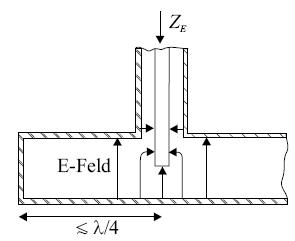
The idea is that the signal from the probe radiates both directions down the hollow pipe. When it hits the plate at 1/4 λ it reflects with a phase reversal and arrives at the probe in phase with the radiation from the next cycle. The combined wave now propagates to the right down the pipe. This is similar to coax to waveguide transitions between coax and rectangular guides as well.
Hello, thanks for your answer.
You wrote
"This is similar to coax to waveguide transitions between coax and rectangular guides as well."
-> this is an Coax to rectangular waveguide transition.
I dont understand this phase argument.
If the wave travels to the left it will be back with 180degree(90+90) phase shift and is therefore out of phase with the main wave.
elektr0
"...When it hits the plate at 1/4 λ it reflects with a phase reversal and arrives at the probe in phase.."
90+90+180=360
Maybe this would make the situation more clear:
90 deg (going to the plate) + 180 deg (reflecting from the plate) + 90 deg (returning to the probe) = 360 deg total phase shift (in phase with the wave traveling to the right from the probe)
Hello Azulykit,
where does this 180 phase shift come.
90+90 is ok.
...
May be we can understand this additional lambda/4 line as an option to generate an open in parallel, which has no disturbing function.
elektr0
There is a 180 degree shift from the conducting plate.
"....When it hits the plate at 1/4 λ it reflects with a phase reversal...."
go tie a length of rope at one end to a door handle. stand back and hold the rope taught, and send a "pulse" down the rope. Does it reflect back from the doorknob in-phase, or 180 degree phase shifted?
The door knob is equivalent to a metal short circuit.
@biff
please let us try to solve the problem.
I still think it is 90+90=180 degree phase shift in case of a lambda/4 line.
Did you try biff44's experiment? You can actually see the phase shift on reflection. Hang a string vertically (lower end free) and pluck it near the top to launch a pulse down the string and you will see the pulse reflect at the end without a phase shift. The difference is the way the end is terminated.
Another option is to model it in a 3D simulator to watch the way waves propagate in a waveguide.
See if you can run down several coax/WG transitions and make some measurements of the dimensions. Now see if you can explain what you see.
OK.
Let me say:
We got 90 degree phase shift untill the wave hits the plane.
Short circuits have reflection coefficients r=-1, therefore the wave gets 180 degree phase shifted. Traveling back causes another 90 degree shift.
90+90+180 = 360 = 0
Right ?
Another working explanation is:
The SHORT is tranformed into an OPEN, which has no influnence because it is in parallel with the real transition. At least for one frequency.
Does everybody agree ?
elektr0
Yes.
A starting points:
http://www.arrl.org/qex/2006/11/wade.pdf
thanks to all.
Look up this article: E. H. Newman and Gary Thiele "Some Important Parameters in the Design of T-Bar Fed Slot Antennas" , IEEE TAP, Jan 1975. It should be available in a good technical library or if you are a member just get it from the IEEE.
They discuss a slpt antenna but it could also be thought of as a coax to waveguide transition. Page 99 discusses the λ/4 distance and phase shift on reflection.
Thank you Azulykit.
I am an IEEE member....i will read it.