
txco vs crystal oven
pins are:
12v
10mhz
ground
ctrl 0-5v
n/c
An empirical method:
Take a meter and measure referenced to the ground the DC resistance of each pin. The lowest resistance is +Vcc of the TCXO.
Between +Vcc and GND put 12V power supply (- to the GND)
Put a Frequency Counter or Scope probe on the remaining pins and identify which one has a 10MHz signal.
At the end using a second variable power supply (- to the GND), identify the control pin (that is varying 10MHz frequency usually in a range of max +/-5ppm).
How large is it? Show us a photograph, including any labels or logos. Maybe someone here will recognize it.
Does it work? Apply 12V and see what happens. If it's an OCXO, it will probably consume several watts for several minutes, and then decrease power as the temperature stabilizes. An OCXO will usually be a few hundred hertz low until it warms up.
If it is still partially working, there is an easy way. Hook it up to a power supply and current meter. Turn it on and write down the current draw. Come back in 10 minutes and see if the current dropped in half (heater reached temperature and throttled back) or if it is the same (no heater).
http://www.symmetricom.com/Products/...s/StarLite.htm
It is the one on the back of this
I would suspect that since you have GPS for a frequency standard, there is no need to add extra cost and power drain to the product to have your own local frequency standard. The oscillator is probably a vcxo locked to the GPS.
The StarLite data sheet says:
12 watts max, 7.5 watts steady-state. Sounds like an OCXO.
Holdover 1us over two hours. That's 1.4e-10 stability. Sounds like an OCXO.
Cute little product. How much does it cost?
S1195 US
Added after 2 hours 34 minutes:
I took the osc apart and see no heating element just a xtal that reads
A 026343
10.000016
82.8 degrees C
021-1760-0
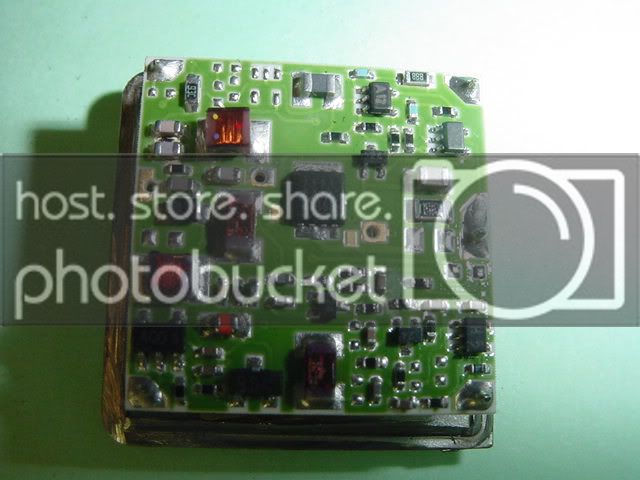
and a board with some components
"82.8 degrees C" suggests there is a heating element hiding somewhere.
My HP 10811A OCXO ovens normally operate somewhere between 80C and 84C.
Try applying power and see if the temperature rises. Heating elements are rugged and yours probably did not fail if there is one.
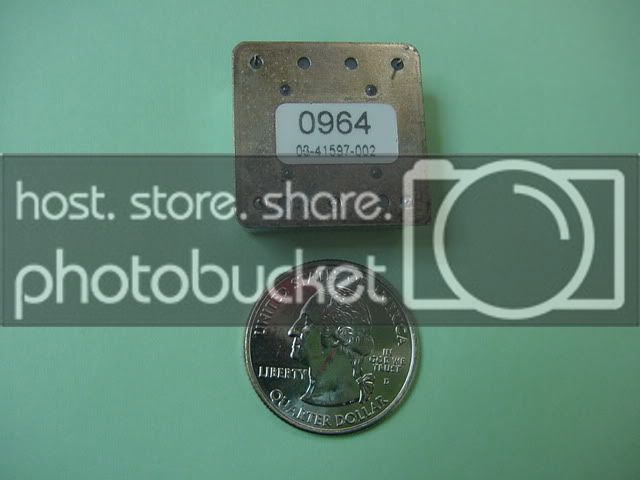
On the other hand, OCXOs are generally large physically to hold the thermal insulation to the outside world. Your photo appears to have a small oscillator case.
The photo shows a package roughly 1" x 1" x 0.5". That's a common size for a miniature OCXO. Example:
http://www.cmac.com/mt/databook/osci...cxo/cfpo-6.pdf
Those mini-OCXO's usually consume only a watt or two. I guess the rest of the board gets pretty warm.
Cosander: Those numbers you found - were they inside the oscillator package, or on top?
those are the numbers on the two lead xtal inside
Added after 17 minutes:
I have tried applying voltage. VCC is shorted to grnd somewhere.
Added after 1 hours 2 minutes:
there is a small black chip that reads
7401
SAA (delta sign)
w16b
I will post pics shortly
Added after 6 minutes:
correction the small chip reads
7404
SAAΔ
W16b
Added after 2 hours 15 minutes:
here is the bottom view I can't use any of these numbers to find the part

here is the osc and its top

After I cut it open

underside of internal board

one thing none of us has thought of until now is to contact the product manufacturer and tell them that you are repairing their board and need the data on the oscillator.
cosander - What's printed on the top of the part? Not the stuff inside.
I can't get your four image links to work. Yes I changed ** to tt.
flatulent - can't do that, it would be too easy. ;)
here is the bottom view I can't use any of these numbers to find the part
http://h**p://us.a1.yahoofs.com/user...QWKDDBbBQB3WSW
here is the osc and its top
http://h**p://us.f3.yahoofs.com/user...QWKDDBLzerMg3mAfter I cut it open
http://h**p://us.f3.yahoofs.com/user...ofKDDBuH0YHHDO
underside of internal board
http://h**p://us.f3.yahoofs.com/user...ofKDDBL1mFK7G4
maybe this will work
the label on the top reads
DATUM TJ
02034-002
10.000MHZ
S/N9097
. 0302
Added after 23 minutes:



Added after 6 minutes:
The manufacturer will fix it for almost the same price as it is to buy one new. They offer no repair support.
From my experience, this is a ocxo because i have ever seen this products. One year ago,when i developed a gps desciplining ocxo system for WCDMA NodeB, 3G. i spared no effort on this type of products.
There are way too many active parts for a simple oscillator and oven controller. Another clue is the crystal frequency being slightly higher than the oscillator frequency. A further clue is the Vc input (for control).
From all of this, I postulate that the oscillator is a VCXO that does the controlling by pulse swallowing.
The control is not an analog voltage, but a digital word telling the oscillator to increment or decrement the frequency by a certain amount.
Operationally, the oscillator is phase locked to the GPS signal when present. When it is absent, the swallowing settings are held and used until the GSP signal comes back.
In a working unit I see only 4.6 dc control voltage no digital. I think most of the circuitry is to make the osc have a cmos output.
Datum is now Symmetricom. They probably made the oscillator. 023034-002 could be an in-house part number, which means they probably won't give you much info.
It looks like OCXO circuitry - a few small parts, a few power parts. Not much thermal insulation though. Was the crystal's (ceramic?) board wrapped in any thermal insulation? I'll bet there's a heating element lurking somewhere under the crystal. Sunoosun, where might it be?
A DAC on the large external digital board probably provides the analog control voltage to the oscillator. That's the common arrangement for a GPS disciplined crystal oscillator. The frequency stamped on the crystal would be its unadjusted frequency at the indicated temperature. The analog control voltage typically provides several kilohertz of adjustment range, depending on how many years of aging the manufacturer wants to accommodate.
Cosander, how about measuring your working unit to determine its power input, control voltage vs frequency response, and output waveform, and then buy an ordinary miniature OCXO with similar characteristics?
as far as insulation, it had a piece of kapton tape around the xtal. I am trying to locate a replacement now. thanks