
What is a RF choke and what are its functions?
Can anyone explain what RF choker is? Is RF choker same as balun? If I want to test a dipole antenna without ground plane, is RF choker enough or I need a special balun?
Also, can you also explain what balun is physically. I knew balun is used to transfer between balance and unbalance signal. In a frequency like 2GHz, how you can make a balun? This is because of the curiousity.
Will balun transfer impedance of 10+50j into same 10+50j.
Thank you
RF choke.Maybe in AM radios with regenerative you will have this.A choke like this is in fact a coil (can be taken from the LW coil..about 200-300 wires or sometimes the author specifys the number of wires)which has a double role:in radiofrequency cut the too strong signals (it works like a high value resistor)and in audiofrequency at the same time through the wire runs the signal received.
Balun: This is a transformer that converts between balanced transmission lines and unbalanced lines (sometimes including impedance conversion as well). Think of a transition between twin lead (or symmetric broadwall coupled microstrip) to a coax as a physical example. A search here or on the web will lead you to plenty of information. The idea is to keep currents off the outside of the cable where they radiate and screw up your antenna pattens. You can evaluate how well a balun is working by running your hand up and down a coax while watching S11. If it changes a bunch. the balun needs work.
choke was addressed above.
not completely ..... RF chokes will also commonly be found in transmitterand receiver stages in series with the DC supply to each of the active devices.
Basic idea .. This allows the DC to pass, but provide a hi impendance path to the RF so that it doesnt enter the DC line.
Dave
all very good idea.... hahaha...
thank u
Hello,
In a supply line a choke is a component ( [lossy] inductance) to block RF frequency signals and to pass DC or lower frequency signal.
The choke function is also used to block, impede, reduce, etc common mode current on coaxial transmission lines. Common mode current does radiate, hence it is mostly not desired.
When you connect a simple half wave dipole (two quarter wave sections) directly to an unbalanced line (coaxial cable), every mA the leaves the center conductor, should return via the inner side of the screen (braid). That current can follow two paths: it can come from the other dipole half, or from the outside of the coaxial screen (undesired). To make sure most current that goes into the inner side of the screen comes from the dipole half, a choke can be used (placed directly at the feeder-antenna transition).
A simple one is a clamp-on ferrite (split core ferrite) or ferrite ring. As the common mode current (current on outerside of screen) generates magnetic field, the ferrite introduces high impedance/inductance to the common mode current. The normal transmission line currents do not generate external magnetic field, so these are not affected by the ferrite around the coaxial cable. This type of choke does not transform impedance (when load equals line impedance).
As such a choke is frequently used to couple an unbalanced line (coaxial cable) to a balanced (symmetrical) antenna, it is called a "balun". A choke can be used as a balun (as in the example), but every balun is not a choke.
Other means to impede the common mode current is via quarter wave sections (eg. Bazooka balun), tuned traps, transformers, quarter wave shorting stubs,etc.
Generally a balun is a device to enable a smooth transition between an unbalanced transmission line and a balanced (symmetrical) antenna. It may also perform impedance transformation.
Besides use as "balun", chokes are also used to avoid outer screen (radiating) RF current in situation where there is an RF voltage across two ground point (ground loop problem). Wide band versions at HF and VHF can be made with the ferrites mentioned earlier. However performance of ferrite materials as choke become less at at GHz frequencies
When you use a clip-on type ferrite (or ring) cable properties do not change, so there will be no impedance transformation, but you may measure other impedance when adding the ferrite. This is because you reduce outer screen current and that may change the antenna's input impedance.
Hi Guys
Correct me if I am wrong. So the choke can be used to block the outside current radiation when a balance dipole is connected with a cable which is actually unbalanced. If this is correct, how can we make a choke(balun) in the measurement, a quarter wavelength tranmission line ?
Thank you very much.
Bo
Hello,
Below an example of a flat strip dipole is given with balun function:
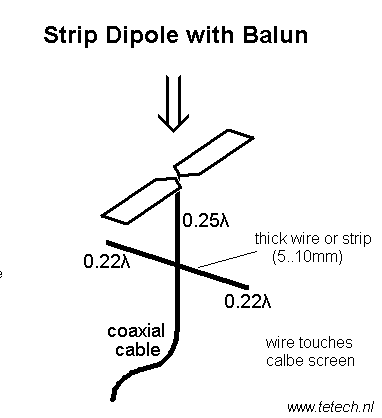
The 0.22 lambda strips provide a low CM impedance point at 0.25 lambda from the dipole"s feedpoint. so the CM impedance becomes high at that point (similar to the quarter wave transformer formula). The stubs are soldered to the coax braid.
As the 0.22 lambda stubs are in the H-field plane of the dipole, the interaction is minimal, hence the effect on overall radiation pattern. I use this type at frequencies where ferrites become less effective (> 1 GHz). You may also google for bazooka balun and sleeve dipole.
The large width of the dipole strips is just to increase useful bandwidth
Thanks for the example. I guess I still have a lot to learn for balun.