
HFSS simulation results differ from IEEE paper results simulated with HFSS
Iv'e simulated an EBG structure described in IEEE paper simulated with HFSS but my results are very far from the paper's results. What's my mistakes?
It's a fat-dipole antenna above an EBG structure. See it.
Attachment 125787
Substrate is FR4 (relative permittivity 4.5) and all dimentions described in the paper:
Ultrathin UHF Broadband Antenna on a Nonuniform Aperiodic Metasurface
Iv'e used PEC for ground plane, microstrip patches, and the antenna. Iv'e used copper for 2mm diameter vias. Iv'e used driven telminal analysis with 1mm width lumped port touching two parts of diploe. Radiation boundry is a 500mm radious sphere (adequately far from the radiating parts).
The VSWR should be under 3 in 430 MHz to 650 MHz as you can see:
Attachment 125788
But there is no vswr less than 5 in my results! What's the matter?
Your attachments don't work.
Just because you used the same software and physical setup doesn't mean you should expect the same results. What convergence criteria did you use? Did you specify a seed mesh? What's your final tetrahedron count?
The mesh quality has the possibility of drastically altering results.
The 'Add an Image' button is reliable and straightforward. After uploading your image, copy all BBC code and paste it into your post.
Hi PlanarMetamaterial! Hi BradtheRad I attach the paper and project file [later].

I hope attachment be valid this time.
Also I should mention that I've left mesh settings as default! Can you/anyone skim the project file and tell me the necessary mesh setting changes?
The project file:
project file.rar
and dears here is the result of the paper
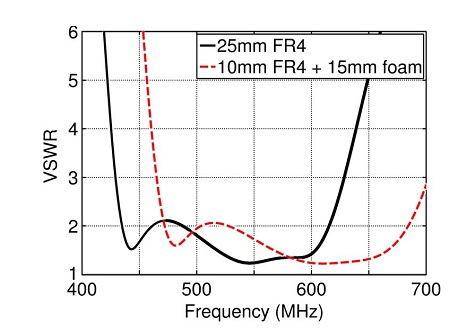
but my results are very high, there is no vswr under 5.
Create a vacuum object that represents the gaps between the Sievenpiper mushroom structures. Then assign this a seed mesh of length equal to half the gap length.
Set delta S of the convergence to 0.01, and have the simulation do two converged passes instead of just one.
results simulation HFSS 相关文章:
- Difference in results of HFSS and ADS
- Results mismatch in ADS 14 and 17 in Co-simulation with lumped/s2p component
- Dissimilarity in FEM Results of Resonant Patch Antenna in HFSS and ADS
- Far Field Results In HFSS
- Why results from EM simulaiton different from schematic simulation?
- Could anyone please help me confirm the Simulation results of ADS2016?