
求助帖,FPGA,前仿真
时间:10-02
整理:3721RD
点击:
刚刚自学FPGA,做前仿真,结果输入信号都是高阻值(Z),检查位宽也配对,实在找不出问题了,谁能解答我的疑惑,谢谢谢谢
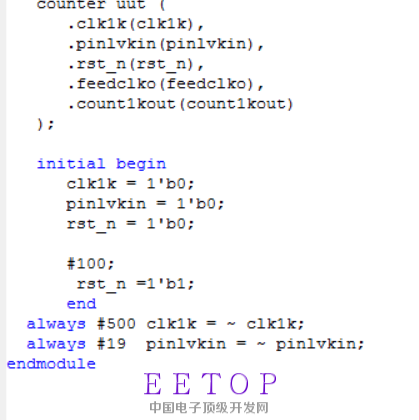 [attach]696590[/attach]
[attach]696590[/attach]
实例化的模块放在initial段后面,再试试
谢谢你呀,不过还是不行呀
- module counter2(clk1k,pinlvkin,rst_n,feedclko,count1kout ); //一秒之内的脉冲数
-
- input clk1k,rst_n,pinlvkin;
- output feedclko;
- output [18:0] count1kout;
-
- reg [15:0] counttest=16'h3e8;//(1000)D
- reg [15:0] count;
- reg [19:0] count1k;
- reg [18:0] count1kout;
- reg [3:0] countnum;
- reg [19:0] feedclknum[7:0];
- assign feedclko=(count[15:0]<=counttest[15:0])? 1'b1:1'b0;
- always @ ( negedge clk1k or negedge rst_n )
- begin
- if( !rst_n )
- begin
- count1kout[18:0]<=16'h000;
- end
- else if (count[15:0]==(counttest[15:0]+16'h010))
- begin
- count1kout[18:0]<=//feedclknum[1][15:0];
- (( feedclknum[0][19:0]+feedclknum[1][19:0]
- +feedclknum[2][19:0]+feedclknum[3][19:0]
- )>>2);//count1kout为1s内的脉冲数作为输出,即为频率
-
- end
- end
-
- always @ ( negedge clk1k or negedge rst_n ) //存储每个单位周期内的脉冲值(T=16ms)
- begin
- if( !rst_n )
- begin
- feedclknum[0][19:0]<=18'h000;
- feedclknum[1][19:0]<=18'h000;
- feedclknum[2][19:0]<=18'h000;
- feedclknum[3][19:0]<=18'h000;
- feedclknum[4][19:0]<=18'h000;
- feedclknum[5][19:0]<=18'h000;
- feedclknum[6][19:0]<=18'h000;
- feedclknum[7][19:0]<=18'h000;
- end
- else
- if (count[15:0]==(counttest[15:0]+16'h010))
- begin
- feedclknum[countnum[3:0]][19:0]<=(count1k[19:0]);
- end
- end
-
- always @ ( posedge clk1k or negedge rst_n ) //产生每个单位时间存储的序号(t=528ms)
- begin
- if( !rst_n )
- begin
- countnum[3:0]<=4'h0;
- end
- else if (count[15:0]>=counttest[15:0])
- begin
- countnum[3:0]<=countnum[3:0]+4'h1;
- if (countnum[3:0]>3)
- countnum[3:0]<=4'h0;
- end
- end
-
- always @ ( posedge clk1k or negedge rst_n )//控制计数周期
- begin
- if( !rst_n )
- begin
- count[15:0]<=16'h00;
- end
- else
- begin
- if (count[15:0]>=(counttest[15:0]+15'h210))//
- begin
- count[15:0]<=16'h00;
- end
- else
- begin
- count[15:0]<=count[15:0]+16'h01;
- end
- end
- end
-
- always @ ( posedge pinlvkin or negedge rst_n ) //在1s内对输入的脉冲进行计数
- begin
- if( !rst_n )
- begin
- count1k[19:0]<=19'h00;
- end
- else
- begin
- if (count[15:0]>=(counttest[15:0]+16'h20))//计数后清零,准备重新计数
- begin
- count1k[19:0]<=19'h00;
- end
- else if (count[15:0]<counttest[15:0])//计数
- begin
- count1k[19:0]<=count1k[19:0]+19'h01;//count1k[19:0]为1s内的脉冲数
- end
- end
- end
-
- endmodule
这是模块代码,你帮我看下,我刚刚自学这个,不是很懂,谢谢您啦
module名是counter2,为什么例化的时候是counter uut?
楼上正解
楼上正解
问题貌似不在这,我把counter uut改成了counter2,依旧没解决,我这样设置激励不觉得有错呀
- module counter_test;
- // Inputs
- reg clk1k;
- reg pinlvkin;
- reg rst_n;
- // Outputs
- wire feedclko;
- wire [18:0] count1kout;
-
- initial begin
- // Initialize Inputs
- clk1k = 1'b0;
- pinlvkin = 1'b0;
- rst_n = 1'b0;
- // Wait 100 ns for global reset to finish
- #100;
- rst_n =1'b1;
- end
- counter (
- .clk1k(clk1k),
- .pinlvkin(pinlvkin),
- .rst_n(rst_n),
- .feedclko(feedclko),
- .count1kout(count1kout)
- );
- always #500 clk1k = ~ clk1k; //产生 1kHz 时钟源
- always #19 pinlvkin = ~ pinlvkin;
- endmodule
仿真的时候CPU实际上是从前向后顺序执行的,所以module的例化应该放在初始化之后
第二次贴的测试文件里面,实例化怎么写在initial模块里了,而且实例化名字也没有,应该会报错吧,还有你说的是测试信号输出的是高阻态?(是指设计模块的输入是高阻吗?),那很有可能就是你端口没连好了,你可以看看测试模块输出的信号是不是高阻
- module counter_test;
- reg clk1k;
- reg rst_n;
- reg pinlvkin;
-
- wire feedclko;
- wire[18:0] count1kout;
-
- parameter CYCLE = 1000;
- parameter RST_TIME=3;
-
-
- initial begin
- clk1k = 0;
- forever
- #(CYCLE/2)
- clk1k=~clk1k;
- end
- initial begin
- rst_n = 1;
- #2;
- rst_n = 0;
- #(CYCLE* RST_TIME)
- rst_n = 1;
- end
-
- initial begin
- pinlvkin = 0;
- forever
- #20
- pinlvkin = ~pinlvkin;
- end
- counter uut(
- .clk1k(clk1k),
- .rst_n(rst_n),
- .pinlvkin(pinlvkin),
- .feedclko(feedclko),
- .count1kout(count1kout)
- );
- endmodule
这里还是用的counter uut?你确定你的module名字是counter吗?你确定编译没有问题吗?仿真中有没有什么告警和错误?也要仔细看看,那些信息更有帮助。比我们在这里盲人摸象好多了。
嗯嗯,好
timescale 设了吗
设定了,单位是1ps,精度1ns
Unable to copy libPortabilityNOSH.dll to the simulation executable directory:
我检查代码,仿真只出现了这一个警告,是不是问题出在这了?
单位是1ns,精度是1ps吧
怎末可能?1ps=1000ns呀
用什么做软件做仿真?。1 ns =1000 ps
这个我检查了,没弄错,没问题,关键不在这
汗,1ns=1000ps。低级错误呀,兄弟。