
关于vhdl的信号和变量以及Verilog的阻塞和非阻塞赋值的一些思考
时间:10-02
整理:3721RD
点击:
最近在看Xilinx公司的ug687-xst-userguide,里边有这样一段程序: signal count_r : std_logic_vector(2 downto 0) := (others => '0');
process(a)
begin
count_r <= "000";
for i in 0 to 7 loop
if (a(i) = '0') then
count <= count + 1;
end if;
end loop;
count <= count_r;
end process;
我给仿真了一下,发现count在每次a变化的时候就加1,而不是计算a中0的个数,百思不得其解。
然后尝试将signal改为variable,如下:
process(a)
variable count_r : std_logic_vector(2 downto 0);
begin
count_r := "000";
for i in 0 to 7 loop
if (a(i) = '0') then
count <= count + 1;
end if;
end loop;
count <= count_r;
end process;
仿真结果正确。
这让我想到了Verilog里的阻塞和非阻塞赋值,代码如下:
always @ (a) begin
cnt = 0;
//cnt <= 0;
for(i=0;i<8;i=i+1)begin
if(a[i] == 1'b1)begin
cnt = cnt + 1;
//cnt <= cnt + 1;
end
end
end
当采用非阻塞赋值时,结果和vhdl里用信号赋值一样;
当采用阻塞赋值时,结果和vhdl里用变量赋值一样,功能正确。
Verilog里的阻塞和非阻塞赋值让很多初学者都很纠结,觉得无法理解,个人觉得这对了,连Xilinx的大神们在写文档里的程序的时候
也是随心所欲,会有考虑遗漏的时候,更何况我等初哥
process(a)
begin
count_r <= "000";
for i in 0 to 7 loop
if (a(i) = '0') then
count <= count + 1;
end if;
end loop;
count <= count_r;
end process;
我给仿真了一下,发现count在每次a变化的时候就加1,而不是计算a中0的个数,百思不得其解。
然后尝试将signal改为variable,如下:
process(a)
variable count_r : std_logic_vector(2 downto 0);
begin
count_r := "000";
for i in 0 to 7 loop
if (a(i) = '0') then
count <= count + 1;
end if;
end loop;
count <= count_r;
end process;
仿真结果正确。
这让我想到了Verilog里的阻塞和非阻塞赋值,代码如下:
always @ (a) begin
cnt = 0;
//cnt <= 0;
for(i=0;i<8;i=i+1)begin
if(a[i] == 1'b1)begin
cnt = cnt + 1;
//cnt <= cnt + 1;
end
end
end
当采用非阻塞赋值时,结果和vhdl里用信号赋值一样;
当采用阻塞赋值时,结果和vhdl里用变量赋值一样,功能正确。
Verilog里的阻塞和非阻塞赋值让很多初学者都很纠结,觉得无法理解,个人觉得这对了,连Xilinx的大神们在写文档里的程序的时候
也是随心所欲,会有考虑遗漏的时候,更何况我等初哥

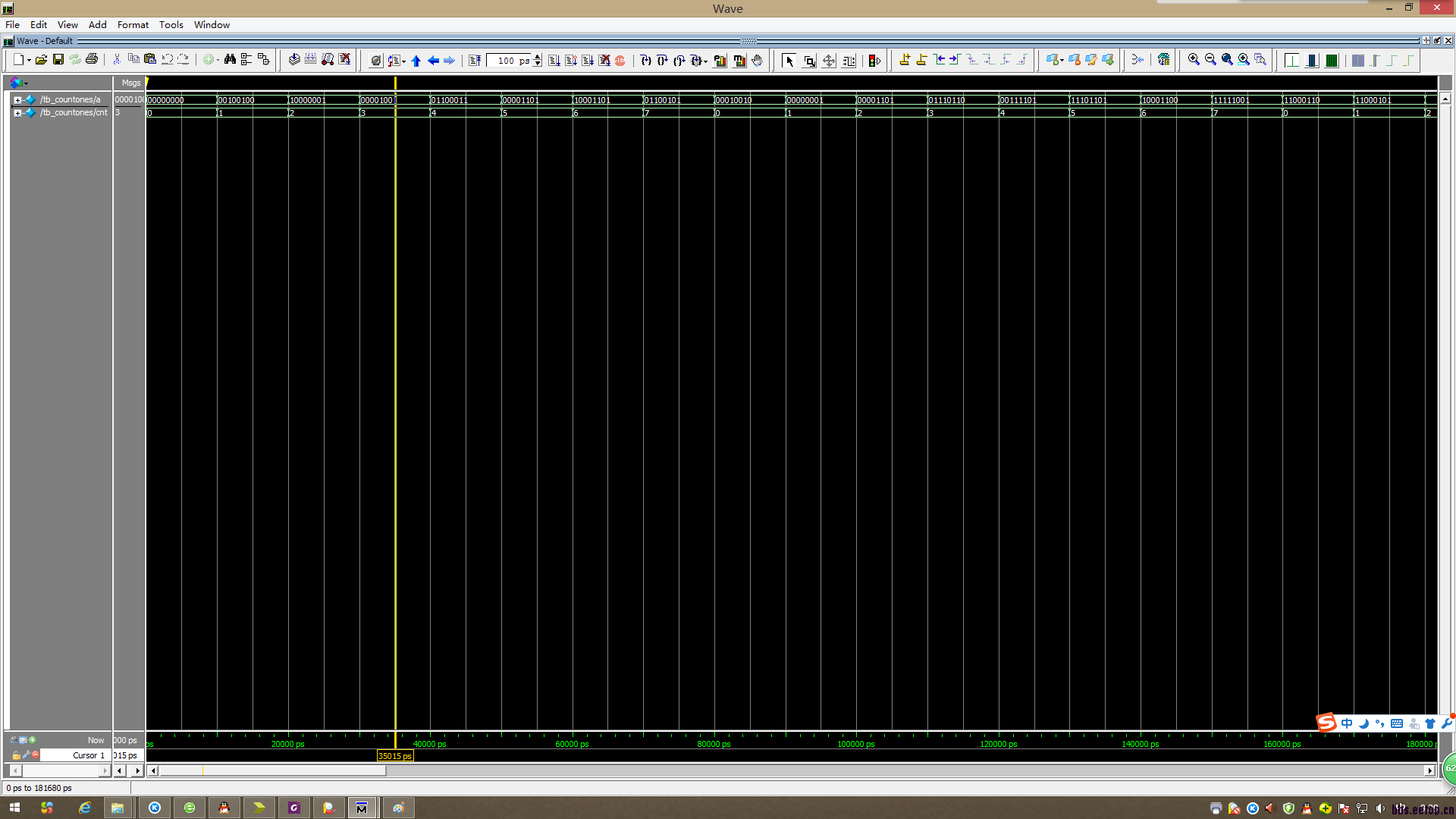
仿真图不小心插进去了,而且重复了,请见谅。
写的有点匆忙,第二段程序有误,修改如下:
process(a)
variable count_r : std_logic_vector(2 downto 0);
begin
count_r := "000";
for i in 0 to 7 loop
if (a(i) = '0') then
count_r := count_r + 1;
end if;
end loop;
count <= count_r;
end process;