
高侧电流检测的测量:集成电路和原则-High-Side
时间:05-27
来源:互联网
点击:
Abstract: This application note describes the use of current sense amplifiers, differential amplifiers and instrumentation amplifiers to measure battery charge and discharge currents in portable equipment, computer notebooks and USB accessories. It compares high side current sense amplifiers with low side differential amplifiers and recommends selection criteria for current sense resistors A high voltage circuit breaker circuit is described to provide system over current protection due to faults and short circuits. Application circuits for a variable linear current source and a programmable 0-5A current source is included.
Current measurement (monitoring current flow into and out of electronic circuits) is an essential skill in the designer's repertoire and necessary in a wide range of applications. Examples include overcurrent-protection and supervising devices, 4-20mA systems, programmable current sources, linear and switch-mode power supplies, battery chargers, and battery-operated circuits for which you must know the ratio of current flow into and out of a rechargeable battery (that is, the gauge function).
As more applications become portable, the demand increases for dedicated current monitors that accomplish their task in a small package and with low quiescent current. The following discussion covers low-side and high-side current monitors and includes their architectures and applications.
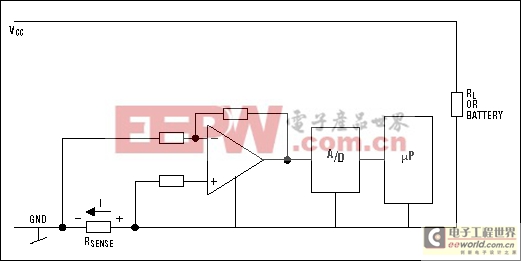
Figure 1. Principle of the low-side current monitor.
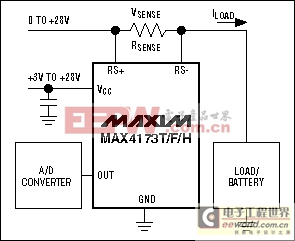
Figure 2. Example of a high-side current monitor.
However, don't let the simplicity of a low-side measuring circuit cause you to overlook the advantages of a high-side approach. Various faults can bypass the low-side monitor, thereby subjecting the load to dangerous and undetected stress (Figure 3). Note that loads connected through path A are monitored, but an accidental connection though path B bypasses the monitor. A high-side monitor connected directly to the power source, on the other hand, can detect any downstream failure and trigger appropriate corrective action. High-side monitors are also well suited for automotive applications in which the chassis serves as the ground potential.
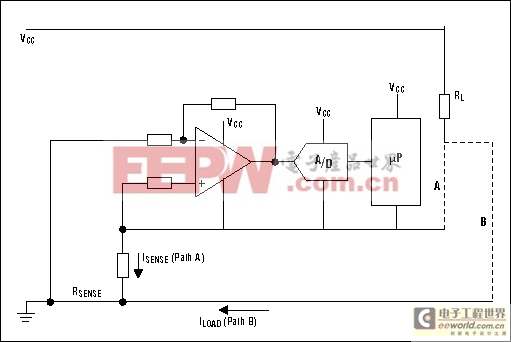
Figure 3. Path B can carry dangerously high currents if the load is connected accidentally to ground.
Current measurement (monitoring current flow into and out of electronic circuits) is an essential skill in the designer's repertoire and necessary in a wide range of applications. Examples include overcurrent-protection and supervising devices, 4-20mA systems, programmable current sources, linear and switch-mode power supplies, battery chargers, and battery-operated circuits for which you must know the ratio of current flow into and out of a rechargeable battery (that is, the gauge function).
As more applications become portable, the demand increases for dedicated current monitors that accomplish their task in a small package and with low quiescent current. The following discussion covers low-side and high-side current monitors and includes their architectures and applications.
High- or Low-Side Monitor?
Most current-measurement applications employ either the low-side principle, in which the sense resistor connects in series with the ground path (Figure 1), or the high-side principle, in which it connects in series with the hot wire (Figure 2). These two approaches pose a trade-off in different areas: The low-side resistor adds undesirable extraneous resistance in the ground path, and circuitry associated with the high-side resistor must cope with relatively large common-mode signals. Moreover, if the op amp in Figure 1 has its GND pin referred to the positive side of RSENSE, then its common-mode input range must extend below zero, that is, to GND -(RSENSE x ILOAD). Figure 1. Principle of the low-side current monitor.
Figure 2. Example of a high-side current monitor.
However, don't let the simplicity of a low-side measuring circuit cause you to overlook the advantages of a high-side approach. Various faults can bypass the low-side monitor, thereby subjecting the load to dangerous and undetected stress (Figure 3). Note that loads connected through path A are monitored, but an accidental connection though path B bypasses the monitor. A high-side monitor connected directly to the power source, on the other hand, can detect any downstream failure and trigger appropriate corrective action. High-side monitors are also well suited for automotive applications in which the chassis serves as the ground potential.
Figure 3. Path B can carry dangerously high currents if the load is connected accidentally to ground.
Traditional High-Side Monitor
Until recently, the many implementations of these two approaches were based on discrete components or semidiscrete circuitry. In their simplest form, such high-side monitors require a precision op amp and a handful of precision resistors. One common approach for high-side measurements has been the use of the classic differential amplifier, which is employed as a gain amplifier and a level shifter from the high side to ground (Figure 4). Though widely used, this discrete circuit has three major disadvantages:- Input resistance (equal to R1) is relative low.
- Inputs usually exhibit a
模拟电源 电源管理 模拟器件 模拟电子 模拟 模拟电路 模拟芯片 德州仪器 放大器 ADI 相关文章:
- 采用数字电源还是模拟电源?(01-17)
- 模拟电源管理与数字电源管理(02-05)
- 数字电源正在超越模拟电源(03-19)
- 数字电源PK模拟电源(04-03)
- TI工程师现身说法:采用数字电源还是模拟电源?(10-10)
- 开关电源与模拟电源的分别(05-08)