
satcom uav mbps loss caculation
what will be the specification of my receiver transmitter.
How can i make a link budget analysis
what topologies i must use?
are spectrum analyser,network anlayser and signal generator enough for testing such a design
Can i use @ds for such a dsign?
i am a new rf engineer and i wanna design such a system but first i must gain experience
Can you help?
I have many questions and not clear about designing such systems.
:idea
Added after 2 minutes:
Also
data rate 45Mbps/10 MBps
distance >LOS< 200km
ground antenna directional
Unmanned air vechile antenna directional
Spread spectrum
1. Start with finding good channel models. You will not have problems with multipath but channel loss will severely depend on the weather (clowds, pollution, rain, ...)
2. Once you know the worst-case link loss, with the maximum transmit power (which is defined by the technology; typically 10 dBm at 12 Ghz I assume), you know the power that arrives at the receiver.
3. If you know your bandwidth, you also know the noise. Spread spectrum leads to processing gain. This defines you receiver sensitivity.
4. If the required sensitivity is higher than the signal you receive in worst case, you will need directional antenna to improve the gain. Sattelite dishes e.g. have gains starting from 30 db!
I think this is a start for your RF system design.
Added after 1 minutes:
What technology do you think you will work in? Discrete or integrated circuit?
Thank you for your reply
I will work with integrated circuit
bandtwidh will be 200MHz so N=KTB=1.38*10e-23*290*200e10e6=-120dB
am i correct?
Also i found a power amplifier that is 25W which is 13dBW so i think i can get more power from my transmitter
Also i made a link budget analysis with BER 10e-6;D=200km;Ku band(13GHz);Both antennas are directional but the gain of airborne antenna is limiited
to 15db because of size limitations;data rate 45MBps;PCM
But i found an enormous power need for transmitter output (antenna gain included) 101dBm ;(antenna 35-45dB assumption)which means i need a power output of 10e3W
where can i find information about link budget analsis.
Also i am lookink for satellite systems but now i am only investigating.
Do you know tools for link budget analyses for such systems
<thank you very much for your helps<
Added after 1 hours 23 minutes:
MPC8-1520 series 125W pulsed Ku-band power amplifier, 12.75GHz to 18.0GHz outdoor solid state power amplifier.
also there are amplifiers with much output power
Added after 3 hours 45 minutes:
transmitter 8 watt ;1dB compression point 42dBm
and SSPA (power amplifier) 20W:1dB compression point 43 dBm
what will be my Tx power in link budget analyses
will it be 42dBm
or 42+43dBm
For a 200 MHz BW, kTB Thermal noise is -120 dBW, or -90 dBm (You need to make sure that you keep the units right)
If you are trying to track a UAV, you will need to either
1-have a tracking antenna, which would be troublesome
2-Use an omni-directional antenna, which will be trouble for the antenna gain.
I don't think you will be able to get 45 MBs over 200 km very easily, that's pretty difficult.
Dave
I agree with RFDave:
-174+6 (noise figure) +10log(2e8)=-87 dbm
It still seems strange to me, having an UAV at 200 km distance is far - very far. I assume you will have to reduce the spec. At
http://www.satsig.net/satellite-tv-budget.htm
you find a link budget calculation for satellite, at 12.75 GHz. This predicts 200 dB channel loss, for a distance of merely 40 km!
What do you need that bandwidth for? HDTV? Even DVB-T needs only 6-7 Mbps.
Nah this is a pulsed amplifier used for radar which needs to transmit very short but powerful RF pulses. Not useful for your app.
This seems a more reasonable alternative, but have you checked the physical size of such an amplifier? Can this be carried by your UAV?
I need this bandwidth because i take real time EO/IR payload (video data), SAR(syntetic aperture radar data, noise camera data and telemetry from airborn
maybe i can't achieve this rate but i need high data rates.
i will use 200MHz bandwith because i also code my data with spread spectrum or another techniques so i need more bandtwidth.My link will be full dublex. Uplink 200Kbps(more important because i don't wanna lose my airborne with a data link error) Downlink 10.71 and 45Mbps.
My airborne is big enough to carry theese amplifiers and transmitters it will weight >3000kg Also i will have SATCOM in my airborne i need 2Mbps data rate for my SATCOM link. The problem is to mount the SATCOM airborne Antenna to my Airborne.
Also i will use a tracking directional antenna with a diameter aproximatelly 1.2meter with ~34db gain.
I think i don't have fresnel zone problem with my data link(what do you think?)
Added after 2 minutes:
Also i wanna talk about another transmitter receiver system at 436MHz with a distance 30 km What data rate i can achieve and What problems will i have with this link.
are the structures of transmitters with these frequencies(436MHz) and Ku band frequencies same
i mean Topologies and the circuits PLL,VCO and TCXO combination for LO for example.
Added after 30 minutes:
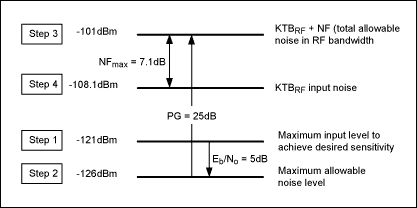
KTBRF(log) = 10 log(1.381 10-23 W/Hz/K * 290K 200MHz * 1000mW/W)
=-90dB
yes you are right i forget 1000mW
Added after 8 minutes:
-174+6 (noise figure) +10log(2e8)=-87 dbm
i think noise figure is not included with KTB
example:
Sounds like an interesting program. Is there a web page that describes the whole thing?
Dave
you can find completed projects by searching UAV concept in google.
Also predator,globalhawk are some favorite UAVs
UAV concept is a developing and new concept