
peak detection
PLEASE.
have u tried the calibration?is it ok if you detect +ve peak and display 2 times which assumes -ve peak same as positive?
ya, its enough to find only the positive peak value and get it multiplied with 2.
my main problem is, the circuits i tried is having capacitors to hold the peak value. but at high frequencies its not getting enough time to charge completely so the voltage across the capacitor is not the actual peak value. how much ever time i give, its not getting charged completely at high frequencies. i think this capacitor need to be eliminated. any idea how to do it?
200 kHz isn't actually a very high frequency. Classical peak detector circuits can handle it with sufficient fast OPs. In any case,
you have to be aware of non-ideal circuit properties, so the design has to start with - besides operation frequency - a specification
of relative and absolute error and acceptable droop.
may be link below help you
http://www.st-andrews.ac.uk/~www_pa/...rt8/Page3.html
For fast peak detects, I quite like the dual opamp circuit:
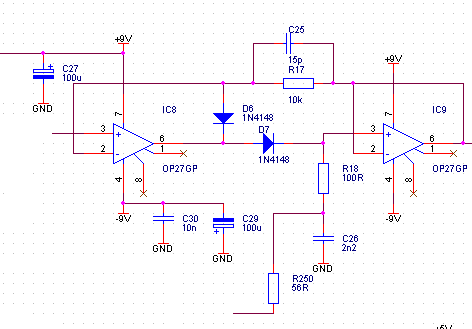
Keith.
I just tried with my circuit but used faster op amp. also switched the capacitor 2 or 3 times while going from low to high frequency. now things are working perfectly...:D
surely i will try your circuit also....
THANKS
Peak detects are quite demanding of opamp performance, particularly slew rate.
Keith.
Ya, slew rate was a problem for me.
A litle simpler circuit here. Be aware that it does only detect at positive half period.

Source:
http://www.matni.com/Arabic/Elec-Inf...TAILS/741.html
The second circuit, that was the thing i said i tried.... But earlier tried with a very ordinary op amp... now ok.
THANKS EVERYBODY.
The problem with the simpler circuits is the output sits at the negative rail so when a pulse comes along it has a long way to get to the peak value. The dual opamp version I posted holds the output one diode volts drop below the input so the output hasn't got as far to go when a peak comes along, so the slew rate requirement is less.
Keith.
ok, will surely try it... and see the difference.
Hi, What OP AMPs did you end up using if I might ask?
John
LF 351, LF 353
Try it.....