
Relationship between transformation ratio and BW of a LC matching network
From the Motorola application note AN721, the BW and transformation ratio relationship is plotted in fig. 1.
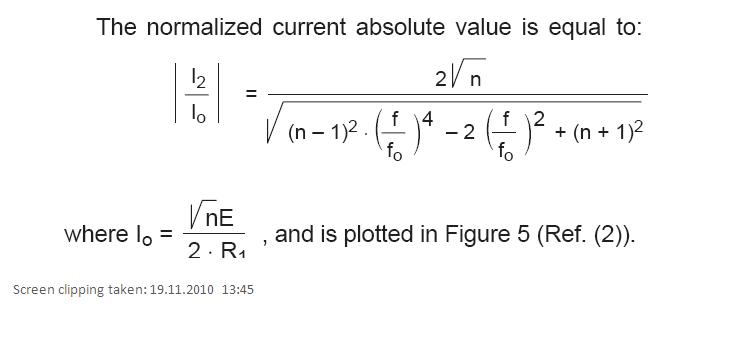
But From the Equation in Fig.2, the same result could not be obtained.
Anyone can give a explanation?
Thanks!
Greater inductance will decrease the operating Q thereby widen the bandwidth.
This ignores the unloaded Q of the coil but generally true. If you are trying to narrow bandwidth by decreasing inductance there will be a point where the unloaded Q of coil starts to have a significant impact.
Ratio of unloaded Q to loaded Q is proportional to the loss of the match.
Hi, thanks.
I mean, I know the plot is correct.
But I cannot understand the equation.
From the application note, the calculation of the equation is not shown. And after I insert the value n=10 and f/f0=0.9 from the plot to the equation, I can't get the correct result that I2/i0=0.9.
Since this AN is very old, I don't think its wrong.
The AN could be found in: http://www.freescale.com/files/rf_if...note/AN721.pdf
In general, the bandwidth is reduced by increased impedance ratios and increased with more LC elements in the network.
There are only two reactive elements shown in the diagram so this can have only one Q solution, which is the lowest operating Q possible for a two element match.
If R1<R2 then X1 would be a capacitor and X2 an inductor (Low Pass filter) . If R1>R2 then X1 would be an inductor and X2 a capacitor (High Pass filter). This is a restriction of having only two reactive elements.
Not sure about app note equations but operating Q will be R1/(2*X1). Since X1 value is a function of R1/R2 ratio should be able to derive equations in apps note.
So anyone have idea about the exact equation between BW and transformation ratio?
Simply speaking that the 2 conclusion are not accurate with the plot and my simulation.
1. the BW is inverse propotional to Q.
2. half the transformation ratio and double the BW.
Thanks!
BW transformation Relationship 相关文章: