Microstrip matching network with impedance discontinuity
时间:04-06
整理:3721RD
点击:
Hello guys
I have a rookie question but i haven't managed to fully understand it so here it goes.. I want to transform a 50Ω source impedance to another impedance R+jX. At the end of the line there is a load impedance R-jX (the output is conjugate matched). this matching network consists of a 50Ω transmission line (at the side of the source) and a 100Ω quarter wave line in series. So the signal starts from the source and sees 50Ω (the first segment) and so reflection occurs. But when it reaches the 100Ω line some power will be reflected back right? So even if the matching network is lossless how can i say that no power is lost in the impedance transformation network as soon as a portion of it will be reflected back? Or should i consider this reflection as a loss similar to conductor loss for example?
I have a rookie question but i haven't managed to fully understand it so here it goes.. I want to transform a 50Ω source impedance to another impedance R+jX. At the end of the line there is a load impedance R-jX (the output is conjugate matched). this matching network consists of a 50Ω transmission line (at the side of the source) and a 100Ω quarter wave line in series. So the signal starts from the source and sees 50Ω (the first segment) and so reflection occurs. But when it reaches the 100Ω line some power will be reflected back right? So even if the matching network is lossless how can i say that no power is lost in the impedance transformation network as soon as a portion of it will be reflected back? Or should i consider this reflection as a loss similar to conductor loss for example?
So you basically need a 50/100 Ohm balun, right?
All passive components will have loss (aka Insertion Loss). No way around that. If the balun is designed and manufactured correctly you will have a IL and VSWR (Return Loss) rating. The return loss is the measurement which corresponds to the reflected voltage. The more reflection you have the the lossier your component ends up being.
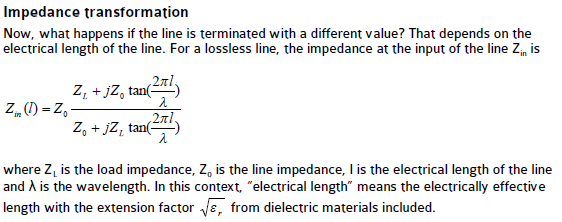
The idea is that reflected signals cancel. Or in other words, the load impedance Zl should be transformed by the quarted wavelength line, so that the input impedance is 50 ohm again. Here is the equation for the input impedance into the line, with arbitrary load impedance. Do the math for your case and see what input impedance you get.