
Simple Methods Reduce Input Ri
Abstract: Charge pumps are a form of DC-DC converter that rely on capacitors instead of inductors for energy storage and transfer. The absence of inductors makes them attractive in situations requiring a low-power auxiliary supply (output currents up to about 150mA). They use less circuit-board area, offer minimal component height, and are easy to use.
Charge pumps can have regulated or unregulated outputs. An unregulated charge pump either doubles or inverts the voltage that powers it and the output voltage is a function of the supply voltage. A regulated charge pump either boosts or inverts the supply voltage. Its output voltage is independent of the supply.
Techniques that reduce capacitor size and optimize output current—fast switching speed and low-on-resistance switches—also produce noise and transient ripple at the input supply pin. Noise can propagate back along the input supply pins, creating problems for crystal-controlled oscillators, VCOs, and other sensitive circuits with poor power-supply rejection. This article focuses on methods for reducing the noise.
Simplified Operation
First, consider a charge pump connected as an inverter. In the simplified version (Figure 1), operation is controlled by 2-phase clock signals with 50% duty cycles. The pump capacitor (charge-transfer component) is charged to VIN via closure of SW1A and SW1B. SW2A and SW2B are open at this time. On the next clock cycle, the closure of SW2A and SW2B connects the pump capacitor to COUT, thereby producing -VIN at the output.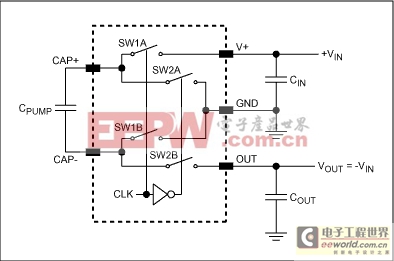
Figure 1. Simplified diagram of a charge pump connected as an inverter.
Next, connect the charge pump as a doubler (Figure 2). As before, operation is controlled by 2-phase, 50%-duty-cycle clock signals. The pump capacitor is the charge transfer device and is charged up to VIN by closure of SW2A and SW2B (SW1A and SW2B are open at this time). On the next clock cycle, the closure of SW1A and SW1B produces +2VIN at the output by connecting the pump capacitor to COUT.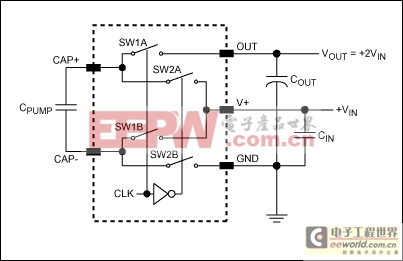
Figure 2. Simplified diagram of a charge pump connected as a doubler.
Input and output ripple is caused by rapid charging and discharging of the pump capacitor. An inverter circuit (Figure 3) built around the MAX665 charge pump and producing 5V across 51Ω, illustrates the input-ripple artifacts (Figure 4). (Ripple produced by the high-current, low-frequency (≤ 100kHz) MAX665 is easily measured.)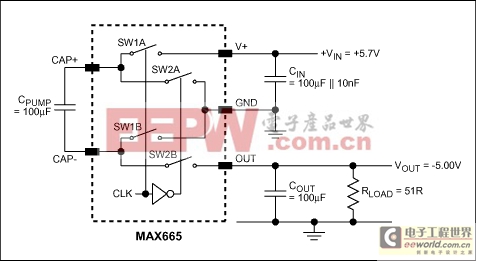
Figure 3. This charge-pump inverter circuit is used for measurements.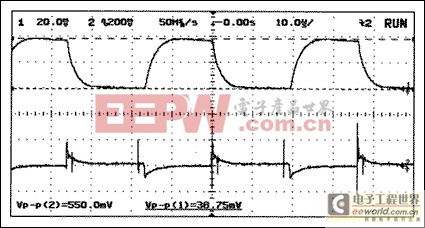
Figure 4. Input voltage and current ripple for standard inverter circuit: CIN = CPUMP = COUT = 100μF, RLOAD = 51Ω, VIN = +5.73V, and VOUT = -5.06V. Input current ripple (upper trace): 100mA/div. Input voltage ripple (lower trace): 200mV/div, AC coupled.
Ripple-reduction Methods
To reduce ripple, you must isolate ripple sources from the rest of the circuit. For best conversion efficiency in the charge pump, you should also minimize ESR and ensure that the input-, output-, and pump-capacitor values are as close as possible to those recommended in the data sheet. The following discussion covers four techniques for minimizing ripple and its effects.
1. Reducing ESR in the input capacitor implies multiple capacitors connected in parallel: N identical capacitors in parallel reduces the input ripple by N-1. Unfortunately, that approach is not very effective in terms of cost and pc-board area.
2. Instead, add an LC filter at the input supply pin (Figure 5). The additional filtering prevents ripple from propagating to other circuits via the input supply trace. As a second-order filter, the LC network minimizes the component count. In addition, its small series inductance produces a minimal voltage drop between the input supply and the charge pump.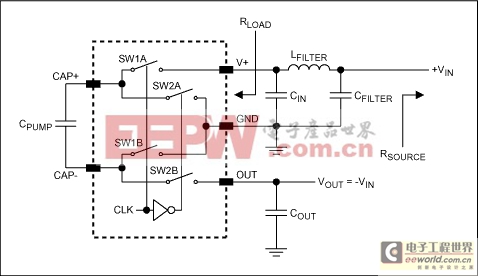
Figure 5. Charge-pump inverter with input LC filter.
The ripple-frequency fundamental equals the pump frequency (FCLOCK/2). Second-order filters attenuate at 40dB/decade, so the ideal filter frequency should be a minimum of one decade below the chosen FCLOCK/2.
The inductor must handle dc currents greater than 1.5IOUT without saturation. For critical damping (ie., with no peaking),
The filter should be critically damped or close to it, given the low impedance values of RSOURCE and RLOAD. Critical damping is not essential to the circuit operation, however. Filtering remains effective even with some peaking at the point of roll-off. A 10μF filter capacitor and 10μH filter choke together provide a 3dB frequency of 15.9kHz and a critical RSOURCE of 1Ω. Figure 6 shows the Figure 5 circuit's amplitude response for various damping ratios, and Figure 7 shows its lower levels of ripple (vs. the circuit of Figure 3).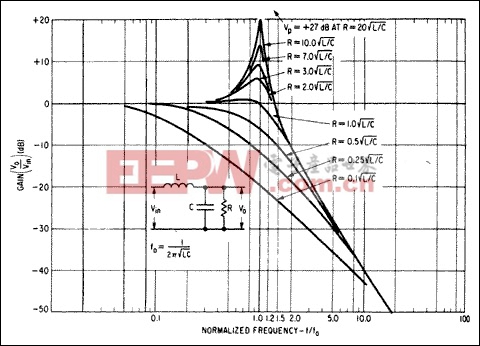
Figure 6. Amplitude characteristic for various damping ratios in the LC-Filter circuit of Figure 5.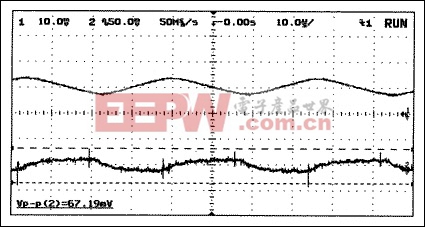
Figure 7. Input voltage and current ripple of LC-filter circuit (Figure 5). CIN = CFILTER = 100μF, and LFILTER = 10μH. Charge pump is MAX665. Input current ripple (upper trace): 100mA/div. Input voltage ripple (lower trace): 50mV/div, AC coupled.
3. Adding a low-dropout linear regulator to the charge pump's input supply (Figure 8) yields an effective general-purpose circuit for preventing the effects of ripple on the rest of the system. The input LDO also operates with smaller capacitors than those associated with a passive LC filter: the 300mA MAX8860 LDO (available in an 8-pin μMAX? package) requires 2.2μF capacitors at input and output; the MAX8863–MAX8864 family of 120mA linear regulators (available in SOT23 packages) requires only 1μF ceramic capacitors. The LDO must handle at least twice the charge pump's output load current, however. When compared with an equivalent passive filter, the added expense of that extra-current capability can place the LDO approach out of bounds in terms of cost and performance (pcb area and attenuation).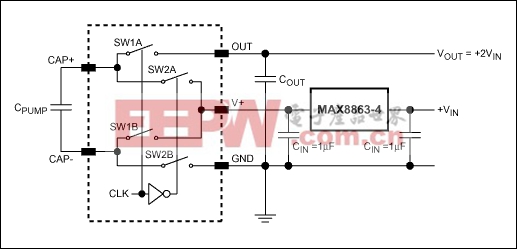
Figure 8. Charge pump doubler with LDO for input-ripple protection.
4. Adding an RC to the input supply (Figure 9) is a single-order version of the LC-filter approach. The RC input is not generally recommended, because the low value of RFILTER required for minimal efficiency loss ( 5Ω) forces a very large CFILTER. Figure 10 shows the effect of adding an RC filter at the input of the Figure 9 circuit, in which a MAX665 with 100μF capacitors generates a 5V output with a load resistance of 51Ω.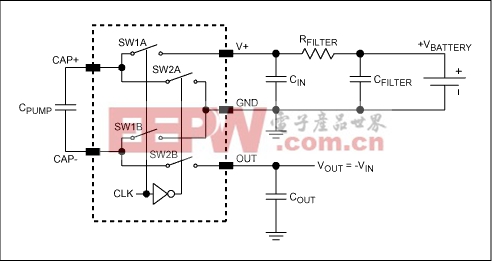
Figure 9. Battery application featuring a charge pump inverter with input RC ripple filter.
If the input supply is a battery, then the effective bulk capacitance of the battery can serve as CFILTER. Because CFILTER is a very large capacitance, the resulting filter is very effective in reducing ripple effects at the battery. An example helps to illustrate the point: the capacitance of an 800mAH Li cell can be derived from:
模拟电源 电源管理 模拟器件 模拟电子 模拟 模拟电路 模拟芯片 德州仪器 放大器 ADI 相关文章:
- 采用数字电源还是模拟电源?(01-17)
- 模拟电源管理与数字电源管理(02-05)
- 数字电源正在超越模拟电源(03-19)
- 数字电源PK模拟电源(04-03)
- TI工程师现身说法:采用数字电源还是模拟电源?(10-10)
- 开关电源与模拟电源的分别(05-08)