
WG/coax transition: probe radiation resistance vs diameter
Yes.
Since the probe's radiation resistance is closely related to in characteristic impedance. And the vary with the same trend when its dimension varying. So the answer is yes.
But can I ask why you are concerned about the probe's radiation resistance. For my experience, that is the value that we usually neglect.
I understand I need proper value of radiation resistance to match the impedance of the probe to the impedance of the waveguide.
I agree there's a similarity to the radiation resistance of an antenna. But it's not a common term in
waveguide technique. Actually length and diameter of the probe stud both influences the impedance
matching. You'll also find alternative transition geometries in literature, that are said to be better suited
for high power, e.g. the lower waveguide transition in the below illustration.
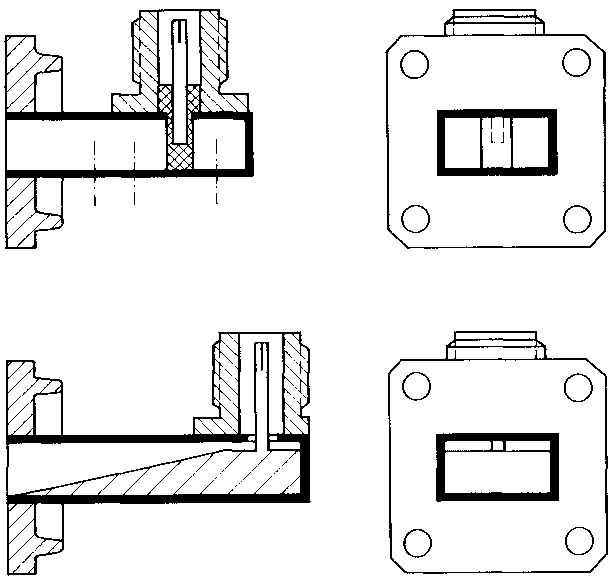
Impedance matching should work independently of how much power is transmitted.
Can you explain?
Right. Better suited means higher power capability, regarding thermal rating and by avoiding electrical arcing.
My literature source (Meinke/Gundlach Taschenbuch der Hochfrequenztechnik) doesn't tell explicitely, however.
transition coax WG 相关文章:
- Re: SMA-Microstrip transition removal for large-signal measurement of PA
- SMA-Microstrip transition removal for large-signal measurement of PA
- HFSS Waveguide to Coax Transition
- Coplanar waveguide to Microstrip transition
- transition length should be a multiple of a quarter of a wavelength
- SIW TRANSITION mode conversion