
Does the Loop direction finder work A 88Mhz -108Mhz band FM ?
Is it possible to achieve good results ..design software chosen s hfss
to do the development ...Please give your suggestions ...
url=http://images.elektroda.net/92_1294537775.jpg]
A loop antenna was used on low frequency radio signals up to low short wave radio frequencies. A Yagi antenna is directional at FM broadcast band frequencies.
A loop antenna resonant at the freq of interest is a VERY effective DF antenna, and a lot easier to manage that a yagi :)
nothing wrong with yagi's they are just bulkier ;)
cheers
Dave
So Yagi Antenna is the Solution .....
---------- Post added at 09:37 ---------- Previous post was at 09:35 ----------
Will the loop antenna Work at 88Mhz -108 Mhz Fm ....Or Is it Better to Stick to a Yagi
yes it will work very well :)
A loop antenna is not accurate because it has the same sensitivity when it points its back or its front at the station and its lobe is very broad.
A Yagi is very sensitive and very accurate when it points directly at the station and its lobe is very narrow.
A Yagi antenna for the FM broadcast band can be pretty big if it is good.
thats irrelevent because the advantage with a loop is the sharpness between the loop being "front" on and "side" on :)
and the front to back ratio of the yagi for direction finding is also irrelevent as its still the front on side on that is used for DF'ing :)
Dave
Hi all,
Suppose we will determine the direction of arrival (DOA) of a signal based on the amplitude measurement from a single antenna.
Consider these two possibilities:
1) use a directional antenna (e.g. yagi) and determine the DOA finding the maximum of the signal strength
2) use an antnna with a null (e.g. loop) and determine the DOA finding the minimum of the signal strength
In 1), the slope of the function Amplitude vs. direction is zero at the maximum. The maximum can not be determined very accurately (unless the lobe is very narrow, for which a big array is required).
In 2), the slope is not zero (the field changes sign) at the null and the minimum can be determined with accuracy. Nulls are sharp.
For this reason loops are used in direction finding. They give better accuracy.
Regards
Z
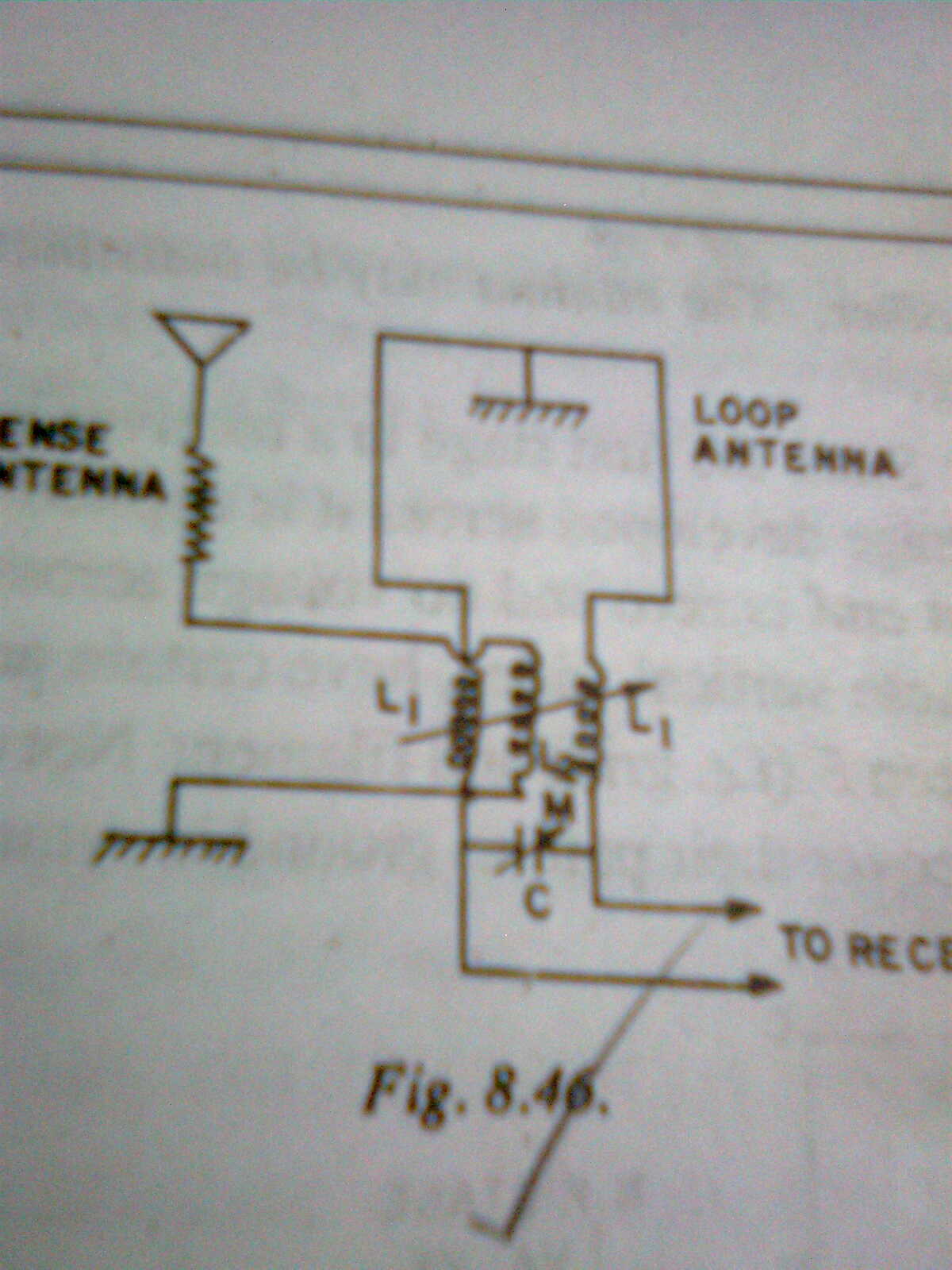
If we Use a vertical antenna along with a loop antenna ;will it work work better than yagi ..In circuit It shows one loop antenna to find the line of arrival and plus vertical antenna
Dave is absolutely correct in this. For DF purposes, you use the sharp null.
There are ways to add some signal from a fixed antenna to change the "figure-of-eight" response to a cardiod, which has only one null. This you would use for a automatic radio-compass style system to control the loop position.
If adjusted by hand, then a second yagi to tell which side of the land the signal is coming from is useful. To get a good null from a VHF antenna like that needs a good gamma match section or a small shielded Faraday loop feed.
Search with keywords "magnetic loop antenna". There are lots of designs out there from the "foxhunt" enthusiasts. These will work well, only needing tuning to the 100MHz region.