
2nd order butterworth BPF Quality versus BW problem
i am a masters student facing a rather difficult problem
Is it possible to design a 2nd order butterworth BPF ?
i mean the mid freq. and the BW are givens , yet he wants a butterworth filter
doesnt butter worth already specify the Q:quality factor for me!?
how do i set the BW, then
i think that it is impossible to be done unless its a 4rth order!
the question wanted to use the salen key configuration but i am open to suggestions.
Thanks in advance
It is possible to design a 2nd order butterworth BPF. Actually, it is very easy to design it. If you have a 2-pole chebyshev filter, you increase the coupling between the two resonators, it becomes a 2-pole butterworth filter.
Thanks but could you please elaborate... :)
---------- Post added at 22:09 ---------- Previous post was at 22:05 ----------
I think i should explain that i am interested in an ACTIVE filter
also i really want a realization because my biggest weakness is a whole lot of maths that is meaningless in the face of real life R's C's and Opamps...
I notice, that you find different definitions in literature what a 2nd order bandpass is.
Mostly, it's understood as a filter with a second order polynomial in the transfer function, in other words a bandpass filter has always an even order (2, 4, 6 ).
Others understand it as a filter with two complex pole pairs, constructed by a low-pass to band-pass transformation of a 2nd order low-pass. In this view, bandpasses can be of any order (1,2,3,4). The latter definition is e.g used by the Filter Solutions tool.
So i can construct a "second" order BPF out of two 2nd order devices in series (a LPF and a HPF)
even so it will be actually have a FOURTH order polynomial in the transfer function, it may be refered to as 2nd order ... hmmmm interesting
actually that may be the case, so i will think about it , thanks FvM :)
if any one else still have suggestions i am still here :)
High-pass/low-pass combination is a different thing. They are sometimes used for wideband bandpasses, but don't implement known filter prototype like Butterworth.
Ok now i am confused again ... :)
so could you please give me an example as to "filter with two complex pole pairs, constructed by a low-pass to band-pass transformation of a 2nd order low-pass."
Like this:
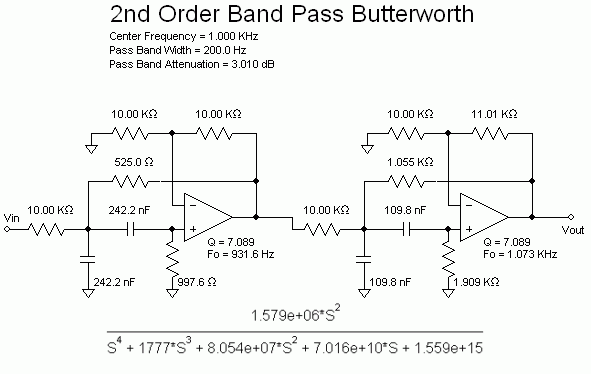
ok so is this a correct answer?
[IMG]
Also i calculated the gain of each stage as A/3-A is this correct?
8)
As said before, a high-pass/low-pass combination can act as a bandpass, but it's not a butterworth bandpass.
mmm thanks
i think i got it :)