
Transmitter power vs distance
Along with the above result different signal should be modulated and it is passed through the channel with different transmitter position..
finally plotting the result of all the signal with different transmitter position,plotting the power vs distance.
how to do this in matlab
plz help
Try better a real experiment. You will be surprised how reality differs from models!
In a simulation you would usually refer to Friis transmission equation
Friis transmission equation - Wikipedia, the free encyclopedia
I have been using a free program called Radioworks recently, and although you can always question a model, they give you 6 different models to compare against each other!
RadioWORKS 2.0.41.0 free download
is this through air ? waveguide ? coax ? some other medium ?
assuming its for air (free space)...
here's a file I did for my microwave pathloss talks with the formula for working out losses at various freqs
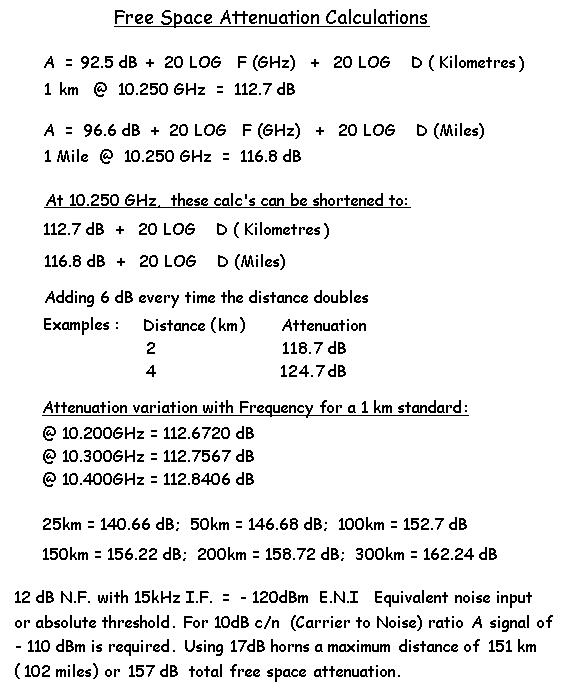
Dave
Hi, Dave,
what's your theory for free space? In microwave point to point, usually at 10GHz, the transmitter output power is +20dBm. Assume the antenna gain is 20dB, so the receive power is +20+20+20-112=-52dBm at only 1Km, that sounds a little small. Because at this situation, the receiver power is greater than -40dBm actually.
The -112 dB free space attenuation is obviously the result of Friis equation. I don't see a chance to cheat it, respectively get less attenuation in case of your microwave example. You can check it with any RF text book.
Sorry, I estimate the antenna gain errorly. For 10G, with 1M diameter antenna, the gain=4*Pi*S/(lamda^2)=40dB. So for 10G, the rx level is +20+40+40-112=-12dBm for 1Km.
Dave is right.
Hey Tony
happy new year :)
they are the standard free space cals (formula) used in multiple textbooks
with that formula you can work out the 1km (1mile) path loss at a given freq and as said in the attachment you add 6dB every time you double the distance....
at that point it is power irrelevent, those free space losses are then applied to whatever power levels, antenna gains, cable losses etc etc you are using to come up with an overall signal level in dB over a given path
it works and is pretty accurate when applied to real situations
I do a lot of work on 1GHz through to 24GHz. Biff mentioned one program used, I haven't tried it, I personally use UKWtools for doing pathloss calcs, there are a number of others
Cheers
Dave
PS .... yes forget about antenna gains transmitter power etc thats comes next
the formulas just give you the Path Loss for a given distance at a given freq :)
Transmitter power distance 相关文章:
- Power meter in end of transmitter
- Relating Transmitter dBm to uV/m and EIRP
- I need more ideas on underwater transmitter and receiver circuit designs
- CC1101 + SmartRF Studio + old AM HYBRID TRANSMITTER ?
- How FM transmitter/radio works with crystal? What to read?
- can transmitters broadcast at other frequencies?