
How to plot constant current (or voltage) gain circles in ADS?
Thanks and Best Regards,
jianke
there is maxgain circle in ADS, I guess that is corresponding to the max current gain and max voltage gain.
For constant Current Gain Circle, set up port-1 and port-2 like following.
port1(Z=50)---VCCS(R1=50,R2=inf,gain=1)---DUT---CCVS(R1=0,R2=50,gain=2)---port2(Z=50)
You can get current gain as S21 with this setting.
For constant Voltage Gain Circle, set up port-1 and port-2 like following.
port1(Z=50)---VCVS(R1=50,R2=0,gain=1)---DUT---VCVS(R1=inf,R2=50,gain=2)---port2(Z=50)
You can get voltage gain as S21 with setting.
The Designer's Guide Community Forum - How to plot constant current (or voltage) gain circles in ADS? is Cadence Tool Support Forum,
so you can never expect any helpful reply other than Cadence Tool there.
Hi, pancho, Thank you for your reply. I have tried the method you suggested, but the results seem strange. I am sorry I cannot understand the principle of the method, so I am not sure whether the results are correct or not. Could you help me to check the circuits ? The ADS simulation circuits are attached for your review. First of all, there are three questions.
1. The Smith Chart for S21 is different from the normal Z-Smith or Y-Smith Char. I am not sure whether it is correct or not ? Which frequency I should choose, if I want the circuit to work at the highest current gain or voltage gain ?
2. Compared to Constant Power Gain Circle or Constant Noise Circle, the trace of S21 is not a circle. Then it is hard to know how the gain changes. For the two former ones, the center is the highest power gain or lowest noise figure, and then we can see the gain decreases or noise increases with the increment of radius (because there several circles).
3. If I want my amplifier to work at much higher current gain with very lower voltage gain, what should I do to choose the input and output impedances ? You know, with some equations, we can tradeoff between power gain and noise when those two circles in a same Smith Chart. (see the picture) Are there similar equations for voltage or current gain ?
BTW, I keep the default values for R2= 1e100 Ohm (VCCS) or R1= 1e100 Ohm (VCVS) to get the inf value. I never used controlled sources before, so I am not sure they are correct or not.
Thanks and Best Regards,
Jianke
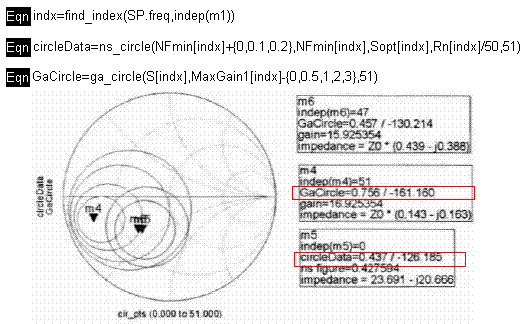
There is no Smith Chart for S21.
You can't use any of "gp_circle()", "ga_circle()", "gl_circle()" and "gs_circle()" for plotting constant voltage gain or constant current gain circles in smith chart.
You have to invoke "Contour Plot" even in SP-analysis or AC-analysis which is often used in HB-analysis.
contour polar() - ADS 2009 -*Agilent EEsof Documentation Center
Lower input impedance and higher output impedance.
To begin with, do you understand followings correctly ?
- Power Gain, Voltage Gain, Current Gain and their relation to source and load impedance
- Concept of constant gain circle
You can never get any valuable information even if you plot constant voltage gain or constant current gain circles in smith chart.
As far as DUT circuit can be in linear operation, both voltage gain and current gain never change even if you change source impedance.
If load impedance is larger, voltage gain will be larger and current gain will be smaller.
If load impedance is smaller, voltage gain will be smaller and current gain will be larger.
You had better reconsider what you want to do and you should do.
- Induced voltages on transmission line by plane wave in HFSS
- Klystron output voltage, cavity field strength
- Negative voltage needed in K-band
- How to set the bias voltage of the BJT in Gilbert mixer
- is DC voltage gain not an important issue to consider in LNA designing?
- Power (Voltage / Current) inducted in rectangle antenna.