
Relationship between Noise and Standing Waves?
I seek your help to clear up some issues that have been recently occupying my mind. I was discussing with someone about antenna impedance mismatch and at some point it came to this idea: would it result in the same way if we used one antenna with high SWR and high gain, and another antenna with good SWR but has lower gain, just low enough so that both antennas produce same EIRP when attached to the same transceiver.
Let me explain in other words: speaking of digital communications, (GSM, WLAN, etc.) suppose we have designed a lousy antenna with very high reflection coefficient (S11= -3dB) and it has a gain of 9 dBi. On the other hand, suppose we have designed a proper antenna with a good reflection coefficient (S11< -30dB or so) and has a gain of 6 dBi. Can those two antennas operate having exactly the same performance? My prompt response was that it was a ridiculous idea to think that way. But then I couldn't find out how an antenna with such high reflection would influence the quality of digital communications. Surely it would increase SWR at the transceiver but I am not sure whether or not excess noise is produced by those standing waves.
Long story short, I cannot argue against this plain logic: Antenna1 is fed with 10mW, 5mW is reflected, 5mW is radiated= 7 dBm and EIRP= 7+9=16dBm. Antenna2 is fed with 10mW, almost all radiated, EIRP= 10+6=16dBm. If the math is correct, then what is the advantage of low SWR?
Could you please enlighten me? Thank you.
As a rather trivial point, higher gain implies higher directivity, so the antenna must be aligned to the remote station. It won't perform well, if omnidirectional communication is required.
If you speak with power amplifier designers, they optimize for every 0.1 dB extra. Why waste 3dB using a poor antenna, if proper antenna matching is possible?
Thanks for the reply, but maybe I need to clarify my statement by adding two assumptions: I only take the communications in the boresight direction into account, so thinking that there are no misalignment losses. And, all the values of gain and s11 are defined at a specific frequency point of operation of course (let's say within a very narrow band, to make things easier).
In the case, better impedance matching should be easy.
Thank you for presenting that point, I appreciate the need of conserving every fraction of power in most applications. But I am thinking of applications such as WLAN, supposing that it wouldn't hurt so much if one can get -1dBi (with impedance mismatch resulting in s11= -3dB) out of an omni antenna which has a gain of 2dBi.
And in addition to that, 3dB is somewhat optimistic. The out-of-resonance S11 can be really bad.
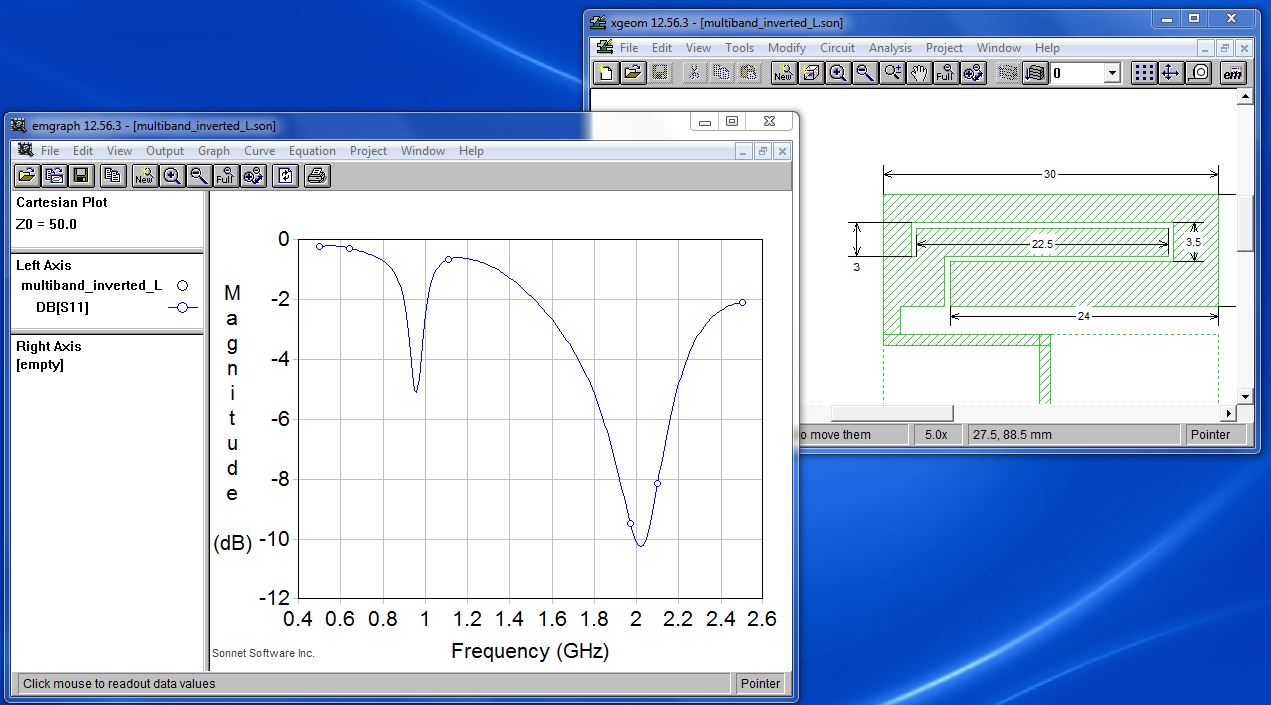
---------- Post added at 20:13 ---------- Previous post was at 20:10 ----------
Sure, you can do that. The only disadvantage is that you loose 3dB in transmit and receive.
Then may I deduce the result that impedance mismatch doesn't have any effect on system noise whatsoever, except for loosing some portion of the power?
No. If you loose 3dB by mismatch, you can compensate the transmit path, but your receive sensivity is also 3dB worse.
I see. Still, would two of the antennas (Antenna1 & 2) I described have the same figure of merit? After all, compensating the mismatch with higher directivity now doesn't seem a bad idea, which surprises me.
Yes.
No. Extra antenna gain means that you need a bigger antenna. Better matching can often be achieved with simple modifications to the antenna. Or maybe with a matching network from one or two SMD components. That is why people focus on matching: it is the more efficient solution.
Thank you very much all, now I get a more clear picture considering all the effort of people trying to achieve more and more compact and low profile designs. I see that excess square feet of radiating element area is simply unacceptable :D