
Is there a Brewster angle formulation for a curvilinear or hemispherical surface?
Thanks.
The Brewster angle has to be applied to the plane (or the line, in case of 2D) tangent to the surface you are considering, at the incident point. If you beam is not punctiform, then you have to calculate the scattered rays point-by-point within the aperture.
albbg, thank you for the answer. I have a half-circle round surface which I would like to couple most EM power to. I found say 70 degrees to be the Brewster angle given the dielectric properties of this surface. Since the surface is round, there will be multiple planes tangent to the round surface. Where would the antenna be placed? At 70 degrees on each of those multiple tangent lines?
Your geometry is not clear to me. Could you post a drawing to better explain ?
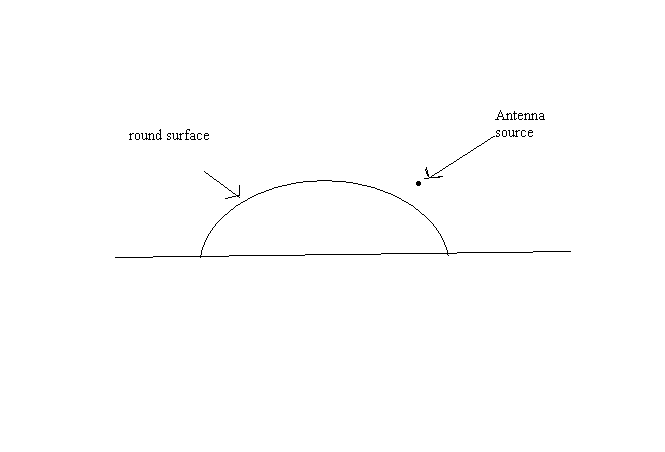
Here you go.
Referring to the following picture:
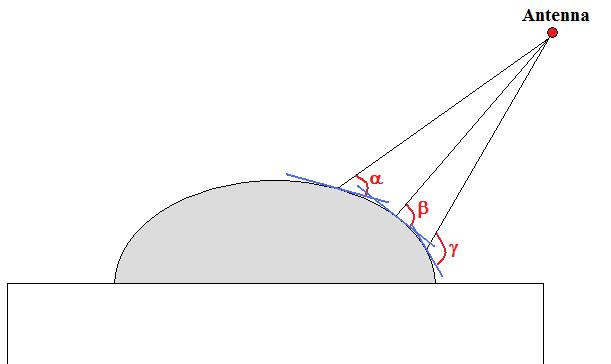
inside the aperture of the antenna, I think you should calculate the angle formed from the rays (coming from the antenna) to the tangent of surface at intersection point (f.i. α, β and γ in the picture) and calculate the reflection coefficient. The optimum positioning should minimize the sum of the reflection coefficients calculated from each ray. In the example I took 3 rays, but to improve precision you should consider more rays.
I agree somewhat. However, while ray tracing (where brewster angle makes sense) may work well at optical frequencies where the wavelength is tiny....at microwave frequencies I would treat the ray tracing as just an approximation. You really need to use a 3D electromagnetic simulator program to accurately analyze the radiation.
angle Brewster formulation 相关文章:
- In which direction we need to go and read the reflection coefficient angles.
- S11 phase angle of waveguide vs microstrip line analogy. Is it correct?
- Operations on S parameters - value of angle
- Formula for flare angle of the bowtie antenna
- How to measure conduction angle in ADS for Power Amplifiers?
- how to vary angle of incidence of a plane wave in hfss?