
Which inductor for which job? Spiral, Conventional or Mline inductor?
Could you please tell me in what situation I should use which kind of inductors? I mean as you see in the photo, the first one is a conventional inductor, the second one is a Mline, and the third one is spiral (My circuit is not a Ic and is a discrete circuit).
To supply drain of a power amplifier (which passes high current) I should use a conventional inductor or a RF choke or Mline (2.3 Ghz working frequency)?
What about in a matching or filter network which work at 2.3 GHz?
when should I use a spiral one? I think when there is no high current which wants to pass through the inductor, but what about its frequency? low or high?
Thanks
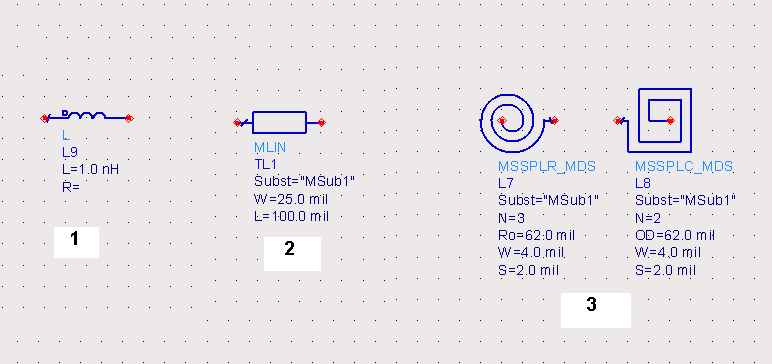
The advantage of SMD elements is that you can have large inductance in a small package. For small inductance values, they also have reasonable Q factor and reasonable series resistance.
"Printed" spiral inductors on PCB can take a lot of PCB space, so the useful value range is limited. They are used to simplify component placement and save cost, if the required value gives reasonable physical dimensions. Q factor can be quite good, if you make it physically large.
Transmission lines are distributed elements with series L and shunt C, and don't behave strictly like an inductor because the frequency dependence is different. However, for narrow band use, they can be used to approximate an inductor. Physically, that layout is even larger than a printed spiral inductor, so it is limited to small values (a few nH).
For bias feed in narrow band circuits, the usual approach is to use a narrow lambda/4 line with a radial stub at the end. Radial stub => RF short, transformed by a lambda/4 line => RF open. This is not physically small, but gives good RF blocking of the DC path with (ideally) no capacitive loading of your RF circuit.
Your answer is so helpful. Could you please show me an image of putting lambda/4 line and radial stub in the formation you have proposed?
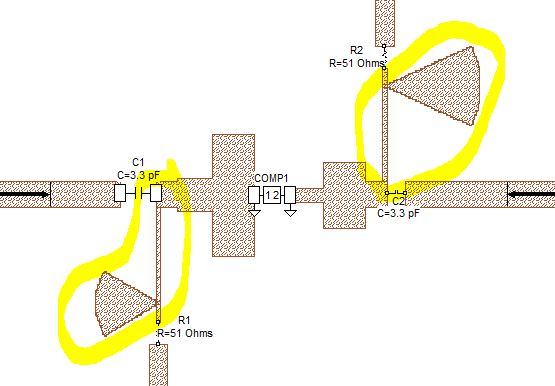
In your case, you would NOT have the series resistor shown in the screenshot
Spiral inductor can be made very small, I had designed that, but its IPR belongs to Nokia.
Yes, if you need small inductance values. Inductance is a function of number of turns and diameter [1]. SMD inductors can stack many turns around an air core or ferrite core, and that enables a wider range of inductance values. For planar ("printed") spirals, we cannot stack turns in 3 dimensions, and we cannot use a ferrite core. This limits the maximum possible inductance value.
[1] S.S. Mohan, M. Hershenson, S.P. Boyd and T.H. Lee, "Simple Accurate Expressions for Planar Spiral Inductances," IEEE Journal of Solid-State Circuits, Oct. 1999, pp. 1419-24.
Consider also Octagon type inductors that are compromised between spiral and square equivalents in terms of scalability and Quality factor.
No, the small I meant is in size, but the spiral inductance is more than 68nH.
- What is exactly my job status with these experiences?
- Distance between air coil inductors
- How is the maximum inductor value in a technology process is determined
- Transmission Line vs Lumped Inductor Choice in Distributed power Amplifier Design
- Why the inductor equation is different in this paper
- Why an input inductor required in all GPS LNA?