
opamplifier
I need an operationnal amplifier with a voltage gain fo 20. Could you suggest me components please?
I am not a specialist in the OPA domain, that's why I need your help.
The most important point is FREQUENCY.
When you have to amplify signals not higher than - let′s say - 10 kHz you can use any of the general purpose amplifiers. For higher frequencies you should try to find an amplifier which has a transit frequency (Gain-bandwidth-product) which is at least 100 times higher than your upper frequency limit.
After you have selected the opamp, you select two resistors in the lower kilo-ohm range with a ratio 19:1 for the feedback path. Thats all.
Added some time later: I forgot to ask: What amplitudes ? Any restrictions regarding power supply ?
ok, thank you giving me these informations, the signal BW is 36 MHz at the OPA input and I have no restriction in bias supply voltage, I can do what I want.
The input voltage signal is 0V-1V.
I tried to do what you suggest me with 2 resistors and an OPA "LMH6672" from National Semiconductor . I give the datasheet if needed.
The 2 resistors are as described in the pictures, I chose R1 = 52.6 ohms and R2 = 1 kohms, consequently R2/R1=20-1=19 according to the theory.
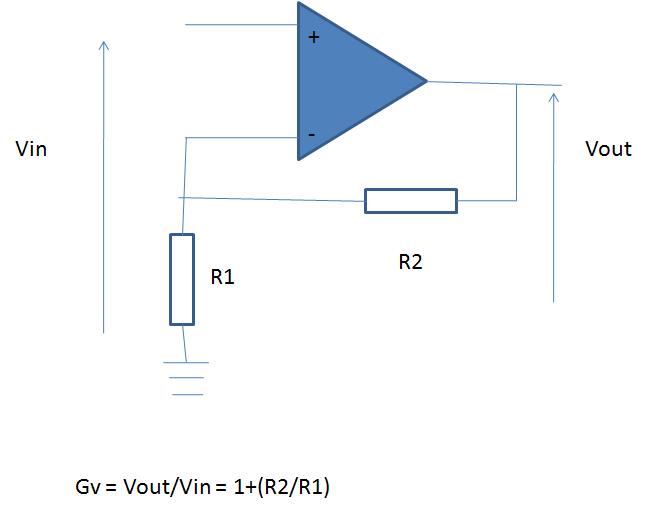
But at the output of the OPA I got an amplified voltage signal which looks like the input signal but it seems the ratio between OUT and IN is only 8, the output voltage excursion is 8 Volts approximately, and I need 20...
Look at the data sheet (page 10, upper right). You′ll see that a gain of 20 dB (factor 10) is possible only until app. 3 MHz.
You need a gain of 26 dB (factor 20) at 35 MHz.
This is not possible with the opamp chosen by you. You need another opamp with a very high unity gain bandwidth (app 1 GHz). Such an IC is available on the market - however the layout may be critical because of the high frequency. Be careful.
Good luck.