
do i get the right result for co/cross polar in antenna? im using ludwig3. tq
i get this result of co/cross polarisation as in attachment
is it correct?
first diagram is taken at phi 90degree, while the second is at phi 0degree

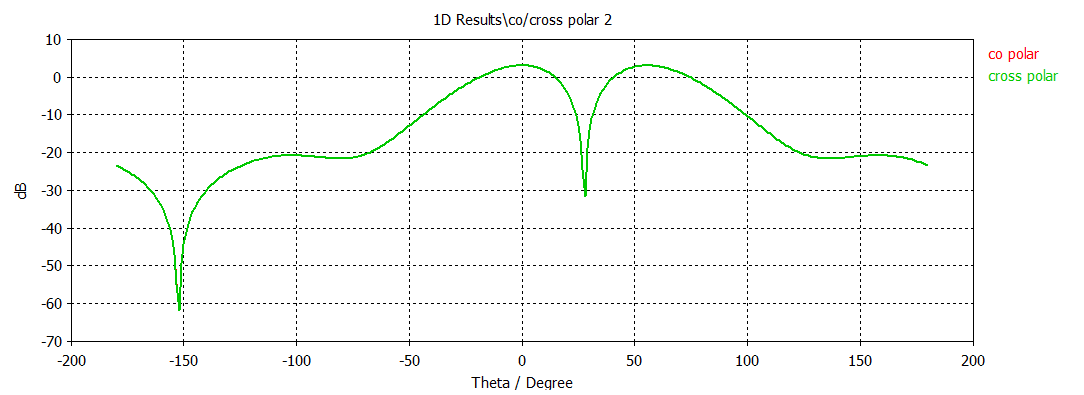
i know that co polar shud be greater than cross polar as cross polar is unwanted.
but if the case that , at zero degree theta is the value of the two are the same [as in 2nd diagram] is it stil ok?
im im wrong in any ways, please correct me. hope can give me some comments and guidance. thank you
im greatly appreciate it. Thanx.
Hi,
It looks like the simulator takes axis at 0o and 90o instead of +/-45o for evalute the co- and cross-polarized components.
Can you give some description of the array and the evaluation of the results?
Regards
Z
thx for your reply,
so i need to take result at angle of 45 degree?
i was following with some paper (dual linear slant 45 degree polarization) where they shown result of co & cross polar at phi = 0 degree.
i never have tots that it shud be presented at the phi of 45,
ok, i will re-upload again with the result at angle of 45. thank you.
very much appreciate for your reply.
what sorts of result u want ? (gain/directivity/efficiency?)
my antenna is perfectly symetric over x and y plane, with the all the patch element is slanting at either 45 degree or -45degree from principal plane. the overall array like X shape with centre feed using coax.
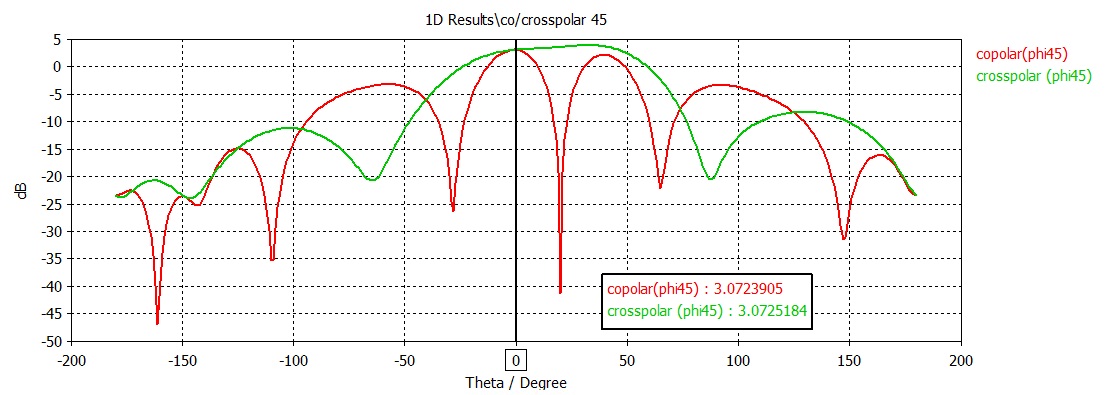
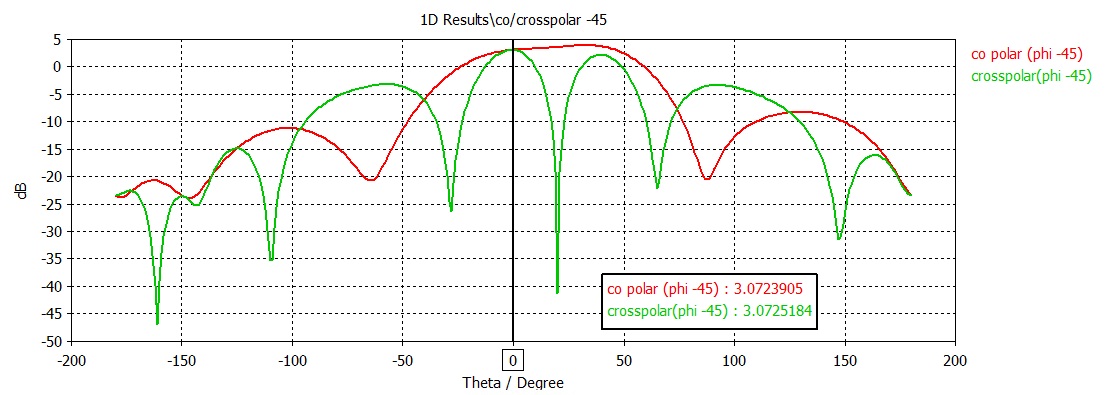
dear zorro, attach below is my result for co&cross polar at phi 45 and phi -45
could you give some comments? thanks a lot
Hi vioamethyst,
I didn't mean phi at +/-45o, but that the principal (co-polarized) component should be at +/-45o.
Take an example:
a) Suppose a dipole in the z-axis. In the xz plane, the co-polar component is Etheta and the cross-polar component is Ephi.
b) Suppose now that the dipole is slanted 45o in the zy plane in order to have a "linear 45 degree slant polarization antenna". [That is what you want, but I don't know in which orientation are taken the 45o. For this reason I asked for a description (a drawing) of the array.]
Now, the co-polar component in the xz plane is no more Etheta, because the co-polar component must be aligned with the dipole. For theta=90o, for instance, it is (Etheta+Ephi)/sqrt(2), and the orthogonal component (the cross-polar one) is zero.
If you continue to consider that the co-polar component is Etheta and the cross-polar component is Ephi, like in the case a), you would get wrong results.
Regards
Z
hi zorro, thanx again for the reply.
my antenna is dual polarized at an angle of 45 and -45 degree (as in attachment PM to you)...could u give further comment based on the image?
thanx again,
thx so much for the guidance, now i know the co polar component must be allign with the antenna (eg dipole)..but im still blur...like in the case a) and b)
is it the plane have to be XZ, or can just be any plane ?
may i know how you derive/get the formula (Etheta+Ephi)/sqrt(2) ?
thanx in advance =]
---------- Post added at 07:09 ---------- Previous post was at 05:56 ----------
in b) like u describe..
at theta 90 degree, means the antenna is in the yz plane (yz plane, with x axis shooting out orthogonal to that plane)
i know the formula is some sort of the resultant component yielding Ecopolar from phi and theta component
like in thePythagorean theorem a^2 + b^2 = c^2
but how u get the result of (Etheta+Ephi)/sqrt(2)
maybe because it involving 3D that make the formula different from what i understand. TQ
It the case of the example a), in any plane containing the z axis the co-polar component is Etheta and the cross-polar component is Ephi.
The projectoins of Etheta on two axis at 45o are Etheta/sqrt(2). The projectoins of Ephi on the same axis are +/-Ephi/sqrt(2). Is it clear?
Regards
Z
owh so let say that on two axis at -45 degree, then the projection of etheta is -(Etheta/sqrt(2)) right?
and that ephi always have opposite sign (+/-) with etheta? meaning to say, now is +Ephi/sqrt(2)
thx a lot for guidance
No; it is a rotation of the axis. In general, cos(rotationAngle) and sin(rotationAngle) are involved. In this case, rotationAngle is 45o.
Regards
Z