
Smith Chart Software. Replacing inductor with resistor
I would like to know if it is possible to replace inductors by resistor, and still use the Smith Chart Software to obtain S21?
Please be kind and explain the reasons.
In what circuit are you wanting to replace and L with an R?
Typically, you use L's and C's because they have frequency-dependent impedance. Recall from your electronics class:
where ω = 2*pi*frequency (in Hertz)
Assuming an ideal resistor, it will have an impedance of R ohms over all frequencies. Inductors and capacitors change impdeance linearly with frequency (again, we"re assuming ideal devices).
P.S. Not sure what this "Smith Chart Software" is, but replacing an inductor with a resistor in your circuit will definitely affect the trajectory of the curves on your Smith chart (and end-point impedance).
Apart from the fact, that most impedance matching designs won't be feasible without inductors, using resistors also contradicts the idea of lossless circuit operation.
Here you can find the impact of each component on the Smith chart.
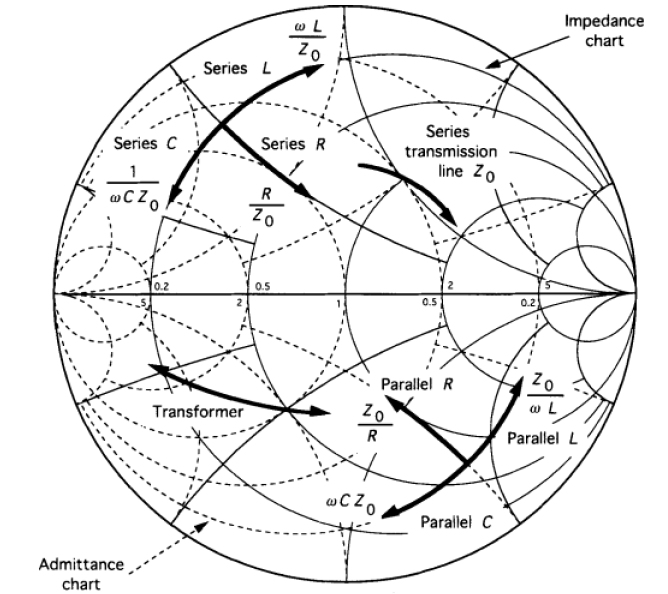
Have never seen a Smith chart with arrows included for resistance. Interesting. Now I only have to mirror everything, as else does my brain not understand.
HI
I hope it's useful for you
Del
The resistive direction usually comes into play when inductor losses are too large to ignore.
You certainly can use resistors in matching netoworks--as long as you do not mind the loss that ensues. One good example is a broadband schottky diode detector, where you basically parallel the diode and a 50 ohm shunt resistor to that you get good vswr (at the expense of sensitivity). Another use is in amplifiers, where you sometimes add resistors to keep a device in a stable region. A third application is where you want to equalize a gain slope (such as throw away gain in an amlifier at lower frequencies) by absorbing power in a resistor selectively with frequency.
Places where you do not want to use resistive matching is where you are looking for the maximum gain, best noise figure, or in a high Q resonant circuit.
These are the equations for using two resistors to match a source Rs and a load RL.
Don't forget about loss introduced...
