
Low profile/thinnest electronic circuits manufacture technologies
Could someone pls advice me where can i get this info/sources:
- minimal thickness as possible of 2 layers PCB manufacture < 0.4 mm abilities/sources***
- minimal thickness as possible flex < 0.4 abilities/sources***
***can hold 1A amplitude of AC current.
- minimal thickness as possible ferrites < 0.4mm abilities/sources- operating freqs 0-1MHz
- And a general question on that issue:
what are the most thin electronic circuits/PCBs' you have ever known? can you please add links?
Thank you all
Take 5 of these to get a 0.4 mm thick PCB.
0.4 mm ferrite should not be any problem but its function will be almost none and would very easily be broken if mounted non flexible, at a thin/flexible PCB.
Max current is depending on what losses and temperature rise you can accept, amount of mechanical stress and aging effects.
Is this enough thin circuits/PCB?
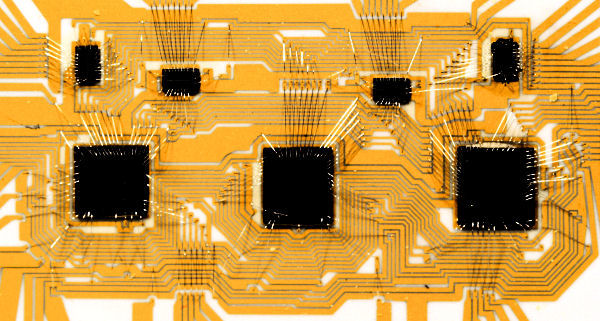
And it is a even smaller circuit inside these three boxes.
Inside one of them:
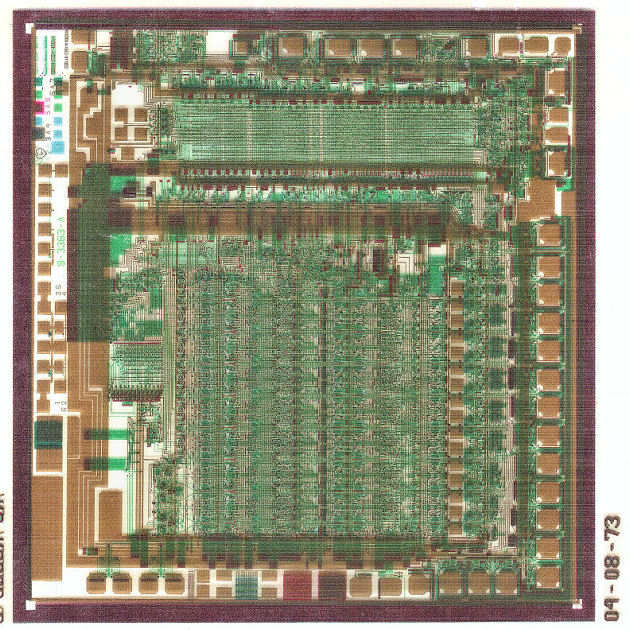
This circuit was designed 40 years ago (1972), 10 years after the first commercial two-transistor IC.
Thanks for your fast reply.
It sort of research i'm doing,
the thing that i'm looking for is to find
- the most new technology of thin electronic circuits manufactures:
* that will be thin as possible (<0.4mm as mentioned)
* that can be in mass production
* that can hold around 5W for few hours
* and not get heat higher than 60 Degrees Celsius
Thanks for you examples do you have more links/companies/sources that do such things
and that i can ask them for the more specific data? because this 0.08 mm Samsung PCB, there is not enough data you can get about how real is this or what is the technology
i need some more specific sources
about ferrite do you have some source/contacts?
about the last 2 pictures very interesting, can you please add more info about the source of it who is making such things? what is the technology? what is the thickness on the pictures?
can i contact them? etc.
thank you and sorry for long letter.
Arye
These both pictures was from HP′s first CPU.
This link is perfect for you then: Intel's 22nm microprocessors.
It have about 4000 times as high transistor density compared to HP's CPU from 1972.
Next step trying reducing size and reducing need for power, is to make single atom transistors and interconnecting wires that are thinner then a single atom. Serious research is ongoing.
Most ferrite producers do custom products. Fair-Rite is one of them.
Size comparison from Intel
attached the requirements of the research:
http://images.elektroda.net/63_1333553337.jpg
I have difficulties to understand the flex PCB technology problem behind the specification. Copper weight, trace resistance and current capability are closely related and more or less material constants. Usual polyimide (Capton) flex substrate can be very thin, 50 to 100 μm is a standard sheet thickness and the material has a high temperature range by nature. Everything else is a matter of application engineering.
The ferrite point is less clear, because it's specific functionality and respective parameters like shape and expected magnetical properties (permeability, frequency, AC + DC flux) are unknown. It's no clear, if rigid or flexible ferrite structures are intended. In the former case, I see mainly a magnetic circuit design problem based on known material properties, in the latter, achievable magnetical material properties can be actually a research topic.
Hi,
For a 2L rigid board, the minimal thickness is 0.2mm we usually make. For flex board, the thickness is often about 0.2mm, as it is very thin.
For rigid board, 0.01 inch circuit, finished copper is 1oz, the max. current could reach 1.5A, theoretically.
For 1MHZ, this is very normal. As regarding to PCB layout, this has no direct relationship with circuit width.
If you want to know the prices about your PCBs, please feel free to contact me. My email is circuit@abp.net.cn
Many thanks for your answers.
the question here is am i missing some technologies for low profile electronic circuits?
or there just PCB, flex, Capton,
are there some new/existing tech that i'm not aware of.
same for ferrite
FvM
what i try to do is to map all manufacture/newest or existing technologies for Low profile circuits that in future i'll be able to choose the best for my application that will be thinnest and feasible w app needs which is not defined yet, its a research in the pre step of a project.
Liberty
your answers are the sort of answers i'm looking for that i could understand my possibilities
in practice.
so what i understood you talking about flex tech? or you might know some other as well?
Frankly speaking, I am not familier with design things. But I could tell you 0.2mm thickness boards would effect the prices.
If you want to know some others, please ask me freely, I would like to anwer if I know it. :)
thinnest profile electronic 相关文章:
- Where to use this low gain and low profile Microstrip Patch Antenna?
- Mathematical representation of low profile non planner antenna
- doping profile in ADS layout
- design and analysis of Low profile UHF RFID tag antenna for liquid bottles
- planar antenna exponential profile
- Random Vibration Profile for ballistic missile environment for OCXO selection