
About InfraRed Project
I've been thinking about a project involving a infrared transmission. I've draw out a circuit picture (attachment) for your better understanding of my thinking.
Can it work? I mean, can the Infrared signal successfully transmitted from outdoor to indoor controller board from a wire/cable?
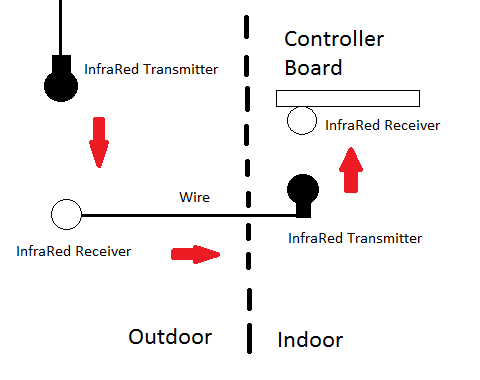
Yes you need IR repeater or extender circuits. something like this :
http://www.aaroncake.net/circuits/ir...er_circuit.asp
http://picprojects.org.uk/projects/images/PICirr.jpg
I see. Good idea.
Seems like the important thing is to know what is the frequency of the Infrared (40kHz in your example). Then, how do we measure the frequency if don't have the Ir transmitter device's datasheet?
You can try other receiver sensors for different frequencies (U1 and U2 from circuits). First try 38KHz.
I see. OK.
My device here have 5 transparent LEDs. Is it a Emitting Ir or a Receiver Ir?
Do we have a LED which can both emit and receive Ir?
For sending needed only one, and for receiving only one also.
Send photo and circuit if you have to see better situation.
Its transparent. With two pins only. So, it's for emitting Ir right? Receiving Ir part must have 3 pins right?
It could be a photo diode or two pin photo transistor as well. Multiple parallel devices are only reasonable for IR transmitter however.
Perhaps I have mis-understood you, as I have not looked at the data/articles, but there are many devices with only two terminals which can be used for detecting light. Photodiodes are PN devices. Even avalanche photodiodes, which are active devices, have only two wires. Cadmium sulphide detectors are another.
Then how do we know it's a receiving Ir part or emitting Ir part without the datasheet? I mean the easiest way to identify?
The question sounds mysterious. In your first post, you reported about existing transmitter and receiver devices, that you want to link. Than you have been asking how t determine the frequency. Finally you don't even now if it's a transmitter or receiver.
There are actually many ways to find out.
- observe the device operation
- inspect the circuit (how are the said devices connected)
- perform electrical measurements
- perform optical measurements (with a photodiode as test receiver)
The first post is the concept I planned to do.
And then I have a device here which got a few transparent LED. So, I'm just asking whether it is a emitting IR or receiving IR.
In this case, I would start with my first suggestion. In other words, ask what the device is doing at all...
If you have a circuit diagram, or can reverse engineer the circuit, then it should be fairlly obvious.
If you have only two semiconductor devices, with one a detector and one a emmiter, I can't think of an easy way to tell them apart just by looking at them. From the outside they are likely to look quite similar. High power semiconductors need to be on heatsinks, so if there are mounting holes for heatsinks, with a flat area of metal, then you can reasonably assume its a high power source and not a detector.
dave