
Pseudo "balanced" feeder with wires of different radi.
What would happen if a typical balanced feeder was changed, so that the radius of one wire was significantly larger than the other? Would it be true that each wire carries and equal and opposite current, so in the far-field the fields cancel and there is no radiation? In the near field, I would expect there to be differences, but I'm not so sure about in the far-field.
Dave
Hello Dave,
when you feed your non-fully-balanced TR line via a common mode provision (so at the feed point, the common mode current is zero), and you connect the load via a common mode provision also, the transmission line will not radiate and zero common mode current will be maintained along the line.
Feeding it via a voltage type balun (provides equal but inverted voltages), will introduce common mode current, hence the line will radiate signifficantly.
Hi,
my plan was to try to make it radiate. You may have seen the Coaxial Colinear (CoCo) antenna, first described by Wheeler. Here's a web page describing one. The web page is flawed, in that the gain is not as high as the author claims (it is about 7 dBi according to simulations with two different 3D electromagnetic simulators), but the basic idea is shown.
http://www.rason.org/Projects/collant/collant.htm
Note how there are transposed sections of unbalanced transmission line (coax).
I was wondering if I could make a variation of that, using unbalanced transmission line made from two wires of different radi. Either of the following two ideas are possible contenders. The one on the right is more like the CoCo antenna, but the one on the left is easier to make, as there are no solder joints. When wires cross, they would be insulated from each other. That's not apparent in the rough sketch below.
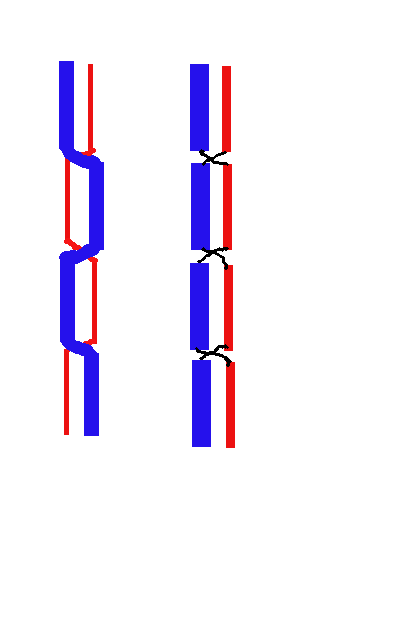
In each case, there is a thin (red) and thick (blue) wire. These cross over each half-wave length.
It"s just an idea I had and was wondering if this would radiate, and if so could I control the radiation pattern to achieve reasonable gain.
The coaxial collinear is not the easiest antenna to make, and its not the easiest to simulate either, although I have done so in HFSS. I was wondering about those two ideas above, which are both based on a unbalanced twin-wire feeder.
I ommitted to draw the quarter wave section at the top which you will see in the web page at
http://www.rason.org/Projects/collant/collant.htm
Some variations of the CoCo have such a section, others do not.
To get some idea of how these ideas might work as an antenna, it would be useful to get some idea of how a twin wire would behave if one wire was significantly thicker than the other.
You probably think I'm mad!
Dave
- SBL-1 double balanced mixer
- Question about single balanced mixer design
- its not working with me (balanced amplifier, power splitter)
- Single balanced mixer ssb generation?
- Biasing of balanced FET amplifier. Does Rdrain_balanced = Rdrain_single / 2 ?
- Using rat-race coupler to combine balanced output of transceivers like NRF24L01,etc.