
Gain Boosting vs Gain Compression
As input power get larger, amplifier's gain would decrease due to nonlinearity.
More specifically, it's because the third order coeff in Tylor Expansion is negative.
Now here comes my question, is there any dvice or circuit that has positive third order coeff?
Thus they could show some gain boosting feature encountering large input signal?
Thx
- - - Updated - - -
All right, so I get this is called "Gain Expansion"
Could anyone give me an exact example how this might happen?
Thanx
I think that can most easily happen with a 2-transistor push-pull class B gain stage. Each half of the waveform is amplified by one transistor and the transistor's transconductance increases with increasing current. This kind of distortion is normally avoided/minimized by adding resistors in series with the emitters/sources.
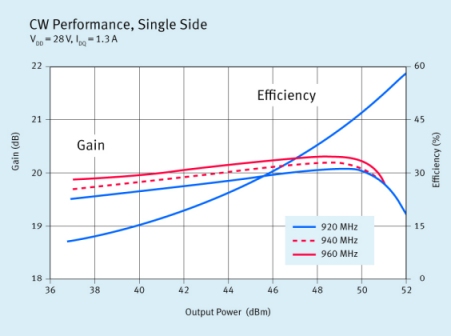
Gain expansion happen mostly in Class-AB power amplifiers, mainly due to non-linearities in the device parasitics, especially capacitances. These non-linearities provide a cancellation of the compression point at a specific power level. A device that have one-tone gain expansion, will have also multiple nulls in the high order two-tone inter-mods products (IM3, IM5), so named sweet-spots. Quiescent current bias setting of the device plays an important role dealing with this non-linearity.
Gain Boosting Compression 相关文章: