
How can I produce frequencies using crystals?
Integrated Crystal Oscillator Modules
http://www.learnabout-electronics.or...tors/osc25.php
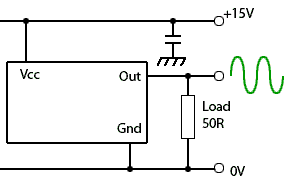
1.090-GHz SAW Clock Oscillator Provides True Sine-Wave Output
http://electronicdesign.com/componen...ne-wave-output
http://www.crystek.com/home/oscillator/saw.aspx
Best regards,
Peter
This remind me on old obsolete 8038 function generator IC.
Using hex inverters is possible, but the design is very dependant on the actual logic family used, and not always a reliable way of doing this.
The classical oscillator topologies are of course the Colpitts, Pierce and Hartley. Each has its own design challenges.
In addition once you go above around 20Mhz, the crystals would have to be used as 3rd or 5th overtone, so again the design would change to do this. There are several sources on the 'net but very few which really give practical oscillator design principles.
A quartz crystal is a resonator with a high Q-factor, and its thickness determines the resonant frequency. The frequency of crystal-controlled oscillator is very stable, this is why quartz crystals are so popular.
If you have a 73 MHz crystal, you do not need a "RF amplifier" but only one transistor. You can use the Pierce circuit where the crystal is connected between base and collector, or a Colpitts where the crystal sits between base and emitter. For more details, find e.g. the ARRL Amateur's Radio Handbook.
For frequencies up to ~20 MHz, a 74F04 hex inverter can be used; the crystal is connected i the feedback loop, and two or three cascaded inverters are used.
would a simple transistor suffice? say, I would use a simple 2N2222 BJT. Would it be enough to be used on the pierce/colpitt's oscillator?
Yes, a 2N2222 is a good choice. It can oscillate at >200 MHz.
thank you very much. I will be testing soon using a 2N2222. :)
I have tried using hex inverters and it works using the circuit found here, http://www.eleccircuit.com/crystal-o...tor-using-ttl/
however, it worked only on lower frequencies (we tested on 4MHz) but once I went to the actual crystals that i needed (39.168MHz, 46.475MHz, 63.3333MHz, 72.673MHz), all of them gave an output equivalent to a third of their rated output. I realize that it could be the overtones that you are talking about however, I don't understand overtones very well. Is there a workaround for this kind of circuit that would allow me to oscillate the crystals at their fundamental frequency?
To repeat what I wrote in an earlier post of this same thread, any crystal rated at more than 20-24Mhz must be operated as an overtone crystal to make it operate at its rated frequency.
All crystals will operate at their fundamental if you use the simpler topologies. This is the easiest mode to operate it at.
So all your stated crystals MUST be operated using an overtone circuit topology to make it work at that frequency.
For example : your 39.168MHz crystal is actually having a fundamental freq of (approx.) 13.056Mhz. NOTE that this is approximate, not exact. Overtone frequency is NOT the same as a harmonic frequency. A harmonic would be Exactly x3, while a 3rd overtone is only approx. 3x of the fundamental.
To make it work at an overtone (3rd/ 5th/..) you need to put in extra elements which effectively suppress oscillation at the fundamental, and allow it for the overtone freq.
This typically involves implementing a lower overtone "trap" designed for a frequency between the desired overtone freq and the lower overtone/ fundamental.
So in fact your last statement above seems to be a little misguided. The printed freq on your crystal is NOT the crystals fundamental freq, it is the freq the crystal has been tuned for at its 3rd overtone.
PLease find the ARRL Radio Amateur's Handbook. Issued annually, since ~1980 you can find several types of oscillators suitable to use overtone crystals.
I was always successful in using a simple one transistor, with a harmonic LC circuit in collector, base grounded by the crystal, and emitter to ground with a ~1 kOhm resistor, WITH a 3-30 pF trimmer in parallel.This trimmer is tuned to select a particular harmonic (crystal overtone).
The output typically was ~1...10 mW at the crystal overtone frequency, and up to 30 mW if I tuned the emitter trimmer to a lower frequency. I had never any problem, used Ge and Si RF transistors.
What specific RF transistor were you using and is it expensive? and if possible, i would like to see your circuit diagram. :) we don't have much here at school and i would like to do a simulation first before ordering components online. :)
produce frequencies crystals 相关文章:
- Metals touching, produce EM waves
- Want to reproduce results of any IEEE paper on design of simple circular patch antena
- Voltage produced from a radio receiver
- Mobile Communication using different frequencies
- can transmitters broadcast at other frequencies?
- Confused with signals with unexpected frequencies in LNA design based on BGU7003