
Feed line Antenna matching
How would i go about connecting these two ? Basically i need a 1:1 balun working @900Mhz
any suggestions ?
from http://en.wikipedia.org/wiki/Balun
An RF choke can be used in place of a balun. If a coil is made using coaxial cable near to the feed point of a balanced antenna, then the RF current that flows on the outer surface of the coaxial cable can be attenuated. One way of doing this would be to pass the cable through a ferrite toroid.(Straw 2005, 25-26)
Does that help?
not really.
I'm looking for a practical solution @900MHz which does NOT add attenuation.
I've seen that wiki article too. It doesn't make sense. Make "a coil" using coax ? what does that mean ?
Is there a connector on the antenna or just 2 wires? The attenuation you will see is going to be due to the impedance mismatches in the transition. Perfect match 1:1 is ideal but you can use some matching elements to match at 900MHz.
Yes i know. That is my original question. Quote "Basically i need a 1:1 balun working @900Mhz"
So how do i make one ?
You could buy one for S1
http://worldwidesatellites.com/to-90...lun-p-505.html
Ok now this is just annoying. Thats a 1:4 balun, not 1:1. Please stop posting to this thread
I'm learning too, so you're welcome for my attempts to help. How about this?
For RG6 @900 MHz quarter wave is about 2.6 inches.
From http://www.g0ksc.co.uk/creatingabalun.html
The 1:1 balun
Fully Symmetrical Coaxial Balun
We need a 1:1 balun at the feed point of our Yagi. This means the balun will connect to a 50 Ohm unbalanced line and present a balanced 50 Ohm output. There are a number of ways to do this in my opinion. The first is a coaxial 1:1 balun as described by I0QM at this link: http://www.iw5edi.com/ham-radio/files/I0QM_BALUN.PDF and for which there is a photo below.
This uses 2 pieces of additional coax cable at the feed point of the antenna. A full explanation is given with the document created by I0QM. This is the best method of producing a fully symmetrical balance at the feed point (using coax cable) without the losses seen in a torroid wound equivalent. However, it does have a number of draw backs. The first is it is relatively narrow in bandwidth. This is course one of the major benefits of G0KSC Yagis (being wide-band) so do we really want to inhibit performance? The next is the additional connections and coax we are introducing which means additional losses in our feed system in addition to another point where weather (water mainly) could gain access to our antenna and feed line and as a result, de-tune our antenna or make it completely defective.
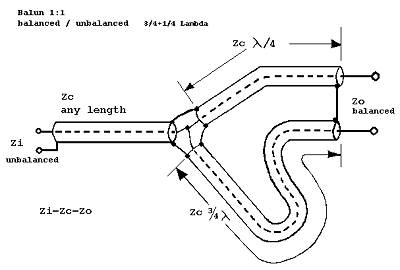
thats perfect.
Of course the simpler way & more common way is to delete the L/4 section, and reduce the 3L/4 piece downto 2L/4 ( = L/2)
Now if only i knew how narrow-band it becomes !?!
For GSM i would need to pass a BW of around 80MHz, which is not really narrow.