
Under water distance detection sensor need.
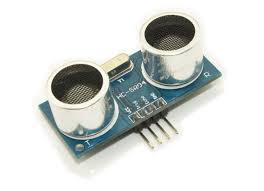
follow sketch sows clearly what i want.
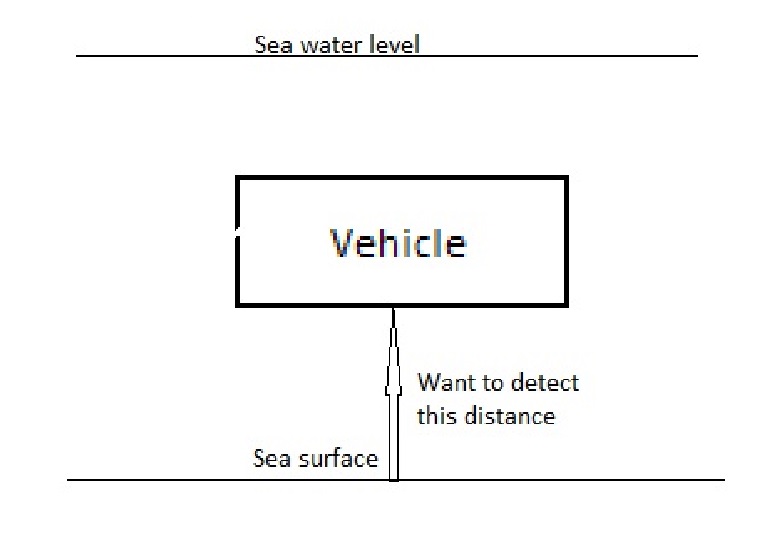
please help any one know about this......
Well that how echo sounders* work, was your sea bed covered in sea weed or some other echo reducing substance?
Frank
* try googling " echo sounder" or use www.wikipedia
Thanks chuckey,
i will try.
It is possible that your transducer is inadequate to work underwater - I don't know what you are using, but generally an echo pulse will be initiated as a fairly high energy pulse - driving signal on the transducer will often be 100-300 milliseconds duration and 10V to 40V, depending on transducer and range. Your reflected incoming signal will generally be much less than 1 volt, or half a volt. Because the speed of sound waves is much higher in the water than in air, reflections can come back much sooner than they would in air. If you are using a prepackaged setup that doesn't allow changing of the "blanking time in which the reception of signals is ignored during and shortly after the transmitted pulse, it may never see the reflection. IT may also need different pulse duration, so taht you can deal with the scattering effects of sediment, particles in water, seaweed, etc.
What about the range of distances you have to detect.
Underwater ultrasonic transducers differ from air transducers at least in two regards:
- they are hermetic/water resistant
- they are designed for an acoustic impedance larger by a factor of several thousand
For water it`s another opera. Different transducers-antennas, otherwise it works. Ask to submarine crew.
What you need is to measure the depth from an underwater device. The are many commercial devices for fishermen to detect fish and sea bed which can be modified for your task. Some use utrasound, some are acoustical. Try e.bay or go to a fishing port, see how their sensors are designed to work under water.
you can use a line with a leaded sinker on one end too
\
thank you for helping me.
for demonstrating the distance is maximum 1 meter.
I believe that if you google "Maxsonar WRC" you will find a range of sonar sensor products from MaxBotix that can work for your application. Possibly may need extra waterproofing with suitable RTV compound, but I've learned that a number of hobbyists have successfully used these in their submersible robotics projects.
Maxsonar WRC has outdoor air sensors, but no underwater sensors. I won't exclude that they can work in liquid media at short distance, but the performance is most likely poor or they'll just fail. Factor 5 higher sound speed and factor 750 higher media density demands a completely different transducer design.
Why not using audible frequency range and simple speaker and mic in good water-resistant enclosures with horn on top?
Speed of sound is slow, so can use DSPing to extract delay time. And also use some funny sound chirps to distinguish them from other sounds in water.
http://www.earthlyissues.com/sonar.htm
Sounds like your not familiar with sound propagation laws, particularly properties like acoustic impedance and impedance matching between different media.
Audibile frequency range isn't the first choice for 1 m measurement range, considering 1500 m/s water sound speed.
A standard underwater ultrasonic transducer using a 1/2" height piezo disk (with about 150 to 200 kHz fundamental resonance) and case/epoxy potting as lambda/4 impedance matching is still the most simple aproach, giving cm resolution with rather basic electronics.
What about using laser with kaleidoscope lens. You can use camera and retreive 3d model of surface and approximate distance to it using some pseudo-3D math. Laser can be turned on and off to distinguish from other bright dots on the sea surface.
I won't deny that these aren't intended explicitly for underwater use, but if one gets the outdoor IP67 (Water resistant, but not water proof) and carefully works with them to improve waterproofing, they HAVE been determined to work, empirically, for many hours by several builders of underwater robotic vehicles, and used them with quite good results, with total range of over 5 meters. Otherwise, I would not have suggested these.
Have you seen trustworthy test results? I would be a kind of "lucky coincidence" if a sensor designed for air interface achieves a similar operation range in water.
I have not personally observed the operation, or seen analytical results. I only have the typed words of several people corresponding on a robotics forum describing their system and what they have observed from its operation. Kind of like what we also have on many other forums, including this one. So, I would say it is no more or no less verifiable than a large number of recommendations on internet forums. I am planning to build a submersible robot myself, and I may give these sensor a try, for they are very cheap compared to 'official' sonar units, so the potential financial risk is small. But, I will not be at the stage to try this for months yet.
Thanks for all.
I follow your guidance and try to achieve to my goal. i hope that in future cases you all are with me like this.
thank you